
When you are applying for an Australian work visa, you need to submit supporting documents for the application process. However, most foreign documents are not in English, and the Australian framework is completely English-oriented. Therefore, applicants need to submit their original documents along with an accurate English translation to make the application successful. But Australia has certain standards when it comes to translating official documents onshore and offshore. In this guide, we will discuss those specific requirements for certified translation for Australian work visa based on your translator’s location. Keep reading to become fully informed.
Key Takeaways on Certified Translation for Australian Work Visa
- DHA accepts translations completed both onshore and offshore, but they have to comply with its translation requirements.
- For translations to be completed inside Australia, a NAATI professional must be hired. Offshore translations must be completed by professionally registered translators or agencies, or government-authorised professionals.
- While onshore certified translations gain quick approval, overseas translations go through multiple authentication checks, which delays visa processing timelines.
- NAATI certified translation, also known as official Australian translation, is highly recommended over offshore translations as it is fast and carries significantly lower risk of rejection.
- Certified translation can be obtained from anywhere in the world using an online translation service.
What You Need to Know about DHA’s Rules on Translation Acceptance
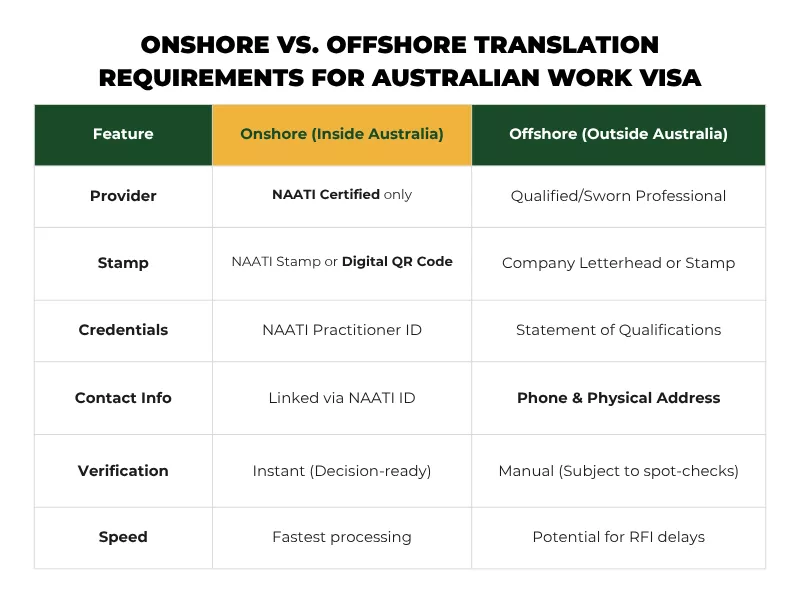
In Australia, the Department of Home Affairs is the governing body of visa-related matters. Your application for a work visa will be assessed by the DHA officials, and your submitted translated documents must be in line with the strict rules specified. Based on where the translation was completed, the requirements are:
1. For Onshore Translations
Onshore translations are those completed inside Australia. In this case, the translation must be done by a NAATI translator. To prove its authenticity and validity, the certified translation for an Australian work visa is required to display these mandatory visual elements:
a. The Certification Statement
The translator must include a formal written statement confirming that the translated English document is a true and accurate translation of the original.
b. The Official Stamp
Translators can use a physical blue-ink stamp, which must clearly list the following details:
- Translator Full Name
- Practitioner ID
- Language Direction (e.g., Mandarin → English)
- “Valid To” Date (Credential expiry date)
Nowadays, translators use a Digital stamp instead of a blue-ink stamp. This is generally a unique QR code, and scanning it will display the same information listed above. It also lets visa officers verify if the translator’s credential is still active and valid.
c. Translator’s signature and the Date of Completion
Next to the stamp, the translator’s physical (wet-ink) or digital signature must be present in the certified translation for an Australian work visa.
The translation completion date must fall before the ‘valid to’ date printed on the translator’s credential stamp.
Note: the “valid to” date refers only to when the translator needs to renew their credential with the board. Your translation doesn’t have any expiration and is valid indefinitely as long as the translator was fully certified on the day they signed your document.
As per the certified translation requirements for Australia visa, missing any of these details will lead to your application being queried, delayed or rejected for being incomplete. Submitting a fake “certified” translation can trigger a 3-year visa ban, so hire a certified translator to translate documents for visa applications.
2. For Offshore Translation
Offshore visa document translation is done outside Australia. In this case, DHA accepts translations provided by a qualified professional translator whose credentials are stated, a registered translation agency, or a government-sanctioned sworn translator, as long as the offshore document meets the translation standards.
As per the requirements, the translation must include:
- The full name of the translator.
- A written statement detailing the translator’s qualifications, experience and credentials (e.g. M.A. in Translation Studies, Member of ITA India, etc.).
- Signed accuracy declaration.
- The date of translation completion.
- An active, valid contact number to allow DHA to complete spot-check audits.
- Formal company letterhead or official corporate stamp (highly recommended, even if not strictly required).
- Registered business address of the translator or translation agency.
Here are some important things to keep in mind:
All the details (translator’s name, qualifications, accuracy statement, date, etc.) must be typed directly in English.
Submitting DIY documents is one of the common translation mistakes that leads to outright rejection. This means you cannot translate the document yourself or have it translated by a bilingual friend, colleague or family member, even if they are proficient in the language pair.
Only a professional translator’s work is deemed authentic. So, using translation tools also doesn’t work.
DHA’s Offshore Translation Authentication Process
DHA has a strict verification protocol in place for processing the translations made overseas. The system relies on the structural accountability of the translator through these actions:
- Credentials Screening: The required declarations made by the translator (name, address, phone number and qualifications) are cross-checked by DHA for authentication.
- Spot-check Audits: As a standard verification protocol, DHA often directly contacts the translator or the agency by phone or email to confirm they have actually translated the specific document for your visa application.
- Database verification: If you have used a recognised translation service or sworn translator body, the case officers may conduct a local check through registries to confirm that the agency is active and legally registered.
Apart from these, Australian embassies and high commissions have dedicated local staff for fraud detection. These experts are highly trained to spot fake local stamps, letterheads, modified templates, etc.
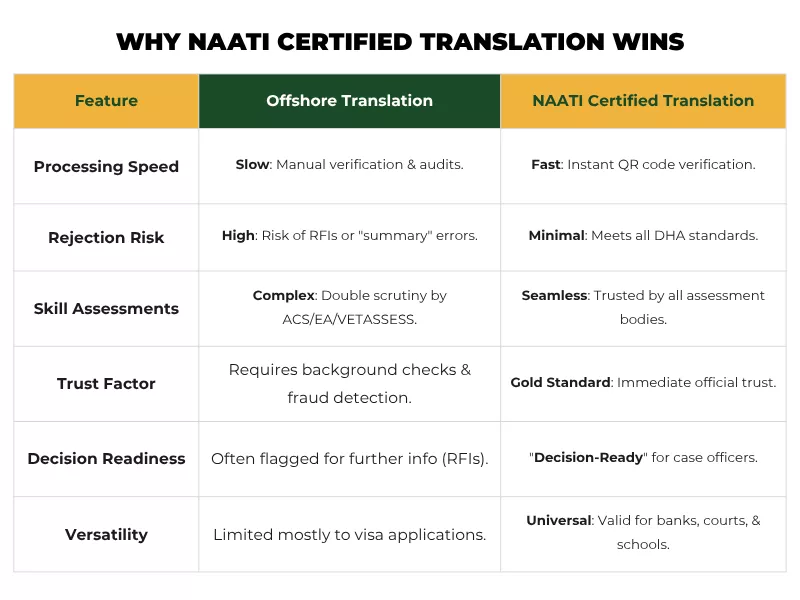
Why Is NAATI Certified Translation for an Australian Work Visa Highly Recommended Over Offshore?
1. Verification of Offshore Translation Takes Longer
Since the offshore translation verification process involves multiple steps, the visa application takes longer to process.
Also, there’s always a chance of getting the translation flagged for review, even for a slight doubt in the local agency’s English. This generally triggers a “Request for Further Information” (RFI), causing further delays in visa processing times by weeks or months.
2. Strict Scrutiny by Skill Assessment Bodies for Certain Work Visa Subclasses
Certain Australian work visa types, for example, point-tested, permanent skilled migration visas like Skilled Independent Visa (Subclass 189), Skilled Nominated Visa (Subclass 190) and Skilled Work Regional Visa (Subclass 491), require completing a skill assessment before you apply for a visa.
For these pathways, VETASSESS, Engineers Australia (EA), or the Australian Computer Society (ACS) act as strict gatekeepers. Assessors from these external skill assessment bodies are the very first people to open, read, and evaluate your original and translated documents during the initial review. While these bodies do accept overseas translations, they often have additional standards alongside regular requirements discussed above. For example:
a. ACS for ICT Professionals
As per the ACS InfoHub – Document Translation Guidelines, overseas translations must be completed on the translating agency’s letterhead and include
- An official stamp
- The name of the translator
- Contact number legibly printed with the translator’s signature
b. EA for Engineers
As per the Engineers Australia MSA Application Guide (Latest Edition), offshore translations must be done by an “authorised translator”. Each copy of the translated document must have the translator’s registered ID, name and contact details.
c. VETASSESS for general/vocational occupations
As per the VETASSESS Evidence Guide, all translations must be made by a registered translation service. Also, if the overseas translator only provided a “summary extract” instead of translating the full documents word-for-word, the submission will be rejected outright.
You get a positive skill assessment outcome letter only if your offshore translation is accepted by these bodies. This letter is mandatory and needs to be uploaded to the ImmiAccount portal while applying for a specific work visa subclass. This process is followed by the second independent verification by DHA as described earlier.
Because the translations must survive two separate rounds of scrutiny, any mistake made by the offshore migration translator due to a lack of nuanced knowledge can cause a double delay, costly rejections and starting the process over again.
3. The Official Australian Translation Advantage
The work provided by translators certified by NAATI (the National Accreditation Authority for Translators and Interpreters) gains immediate trust and acceptance by all Australian authorities.
For operating directly within Australia, these professionals possess deep knowledge about the national framework, from DHA’s visa procedures to the strict requirements of independent skill assessment bodies.
This is why it is highly recommended to use NAATI certified translation for visa translation in the first place, even for offshore. Official Australian translations simply eliminate human doubt and streamline your visa processing. The benefits include:
- Minimal Verification Delays: The NAATI Stamp or QR is instantly scanned by case officers. This quick verification requires no further audits.
- Quality Assurance: Authorities put the highest trust in this certification. The risk of rejection due to critical errors or poor terminology in the translation becomes significantly reduced.
- Universal Australian Acceptance: Aside from visas, these translations can be reused for other matters in Australia and can be submitted to any authorities (government offices, courts, banks, educational institutes, etc.) without any hassle.
Is It Possible to Get a Certified Translation for Australian Work Visa from Another Country?
Yes! You do not have to be physically present in Australia to get an official translation of your visa documents. By using online translation services, you can easily get the job done.
For example, AustralianTranslationServices operates fully online and has a pool of certified NAATI experts. We offer certified translation for Australian visa documents in the country itself and beyond. We cover more than 150 languages, including Arabic, French, Spanish, Hindi, German, Bengali, Chinese, Vietnamese, Japanese, etc.
Here’s how to translate documents for a work visa application:
- Go to the easy-to-use order form.
- Send your translation requirements by uploading the PDFs of high-quality original document scans.
- Specify language pairs and your expected timeframe
- You can instantly check out by paying the quoted price
- Wait for the translator to complete the work
- Get a draft for review and ask for revisions or edits if required
- Receive the high-quality certified translation with a proper stamp and accuracy statement in a digital format (PDFs).
- Do not forget to proofread from your end, as reliable providers accept multiple revisions.
You can also request physical delivery of hard copies, but in that case, delivery time will vary, and eventually, you will be using the digital format only while applying for an Australian work visa.
Note: While notarisation is not needed in Australia, if you are applying for overseas visas, work visa translation requirements by country may vary, and the authorities may ask for it, especially for documents involving sensitive legal materials. In that case, we not only offer notarised translation services for such matters but also offer post-service verification support. To know more, contact us.
Which Documents Need Certified Translation for Australian Work Visa?
Getting the right type of documents translated is extremely important for a successful visa application. Furthermore, different pathways may have individual document requirements. The most common documents that need certified translation for Australian work visa include:
| Document Types | What’s Included |
| Identity & Civil Documents |
|
| Employment Evidence |
|
| Education & Qualification Documents |
|
| Character & Financial Documents |
|
Always check the document requirements specified in your subclass booklet to avoid missing out on important documents.
Conclusion
In the end, it’s entirely your decision whether to use onshore or offshore translations based on your present situation. While both types of translations are accepted as long as they meet the standard requirements, official Australian translations are “decision-ready” and eliminate an extensive independent review process. You can easily get a certified translation for Australian work visa anywhere in the world using online translation services. It is also highly convenient as it doesn’t require visiting any physical office.
Frequently Asked Questions
Is it possible to get a work visa translated urgently online?
Yes! Many online providers offer express delivery options for an extra fee. For example, at AustralianTranslationServices, standard turnaround is 72 hours, but you can also choose from 24-hour and 12-hour timeframes.
How much do I have to pay for translating a visa document in Australia online?
The price of certified translation can be per page or per word. One affordable visa document translation service is AustralianTranslationServices, and the price starts from AUD 60/page. Please note that the final work visa document translation cost will be calculated based on total pages, urgency of delivery, language pair and complexity of the document.
How can personal records that are not in English be submitted?
To apply for an Australian work permit visa online, prepare high-quality scans of your original documents, merge them with the digital PDF of professionally translated versions into a single file, and upload them to the ImmiAccount portal while applying. Make sure the files are properly named, for example: Yourname_DocumentName, to offer better accessibility to case officers.
How long does the Australian work visa application process take?
There’s no definite answer for how long an Australian work visa application process takes, as different pathways manifest different processing timelines based on subclass-specific systems. However, in general, you may expect:
- Temporary work visas (e.g. subclass 482) may take 19 days to 5 months.
- Provisional/regional work visa (e.g. subclass 491/494) 5 to 12 months.
- Permanent Residency work visa, such as a point-test visa (e.g. subclass 189/190) or an Employer-sponsored (e.g. subclass 186), may take 5 to 14 months.
The timeline would be impacted by the choice between official Australian translation and offshore translation. While the former is decision-ready, only taking 1-3 business days, the latter may take 5 days to a few weeks for DHA verification. This additional time may be added to the overall duration of the visa process.
Is it mandatory to use translators from your home country for offshore translation?
It is not mandatory to use an offshore translator from your home country, as DHA doesn’t track geographic matching between your nationality and the translator’s country.

Want To See My Profile — Click Here Michael Brown
- Document Translation Guide for Migration Agents - September 4, 2026
- Why Do Different Australian Authorities Accept Different Translations of the Same Document? - August 28, 2026
- What Makes a Translated Document Admissible in Australian Courts? - August 17, 2026
