

Whether you are travelling to Australia or migrating, you’ve likely come across the term NAATI. The Department of Home Affairs generally requires certified translations of foreign-language documents. If you need certified translations in Australia, you must hire a translator with NAATI certification. Now, you might be wondering what a compliant certified translation must include. This blog covers the stamp, signature, and certification statement that make a translation certified in Australia.
Key Takeaways: Certified Translation Compliance Guide
- Non-English documents translated in Australia must be translated by an active NAATI-certified practitioner.
- Every page requires an official NAATI stamp, NAATI practitioner number (CPN), name, date, and signature.
- All text, seals, stamps, signatures, and notes must be translated without omissions.
- Every translation must include a signed certification statement attesting to a true and faithful rendering.
- Formatting, tables, and page structure must match the source document side by side.
- Footers must display continuous numbering (e.g., Page 1 of 3), with stamps kept within margins.
- Uploads must place the full English translation first, followed by high-resolution colour scans of the original.
- Offshore translations require the translator’s full name, qualifications and contact details on official letterhead.
What Must a Certified Translation Include?
An official, compliant NAATI translation is a legally admissible, verified document. Australian government bodies, including the Department of Home Affairs, universities, and courts, enforce strict compliance standards to ensure authenticity and prevent holds or document rejections under integrity frameworks.
Before lodging your application, review the core differences between a certified vs standard translation to ensure your document meets statutory compliance.
Every compliant NAATI-certified translation must incorporate four core structural and visual elements:
- Practitioner Credentials & NAATI Stamp
- Standardised Translator Notation Conventions
- The Formal Certification Statement
- Layout & Submission Formatting
If any of these requirements are missing, receiving officers may treat the document as an unverified draft, leading to application delays, processing holds, and requests for further information. Now, let us look at the details.
Practitioner Credentials & NAATI Stamp Requirements
Because official bodies set stringent compliance standards, a successful document combines trusted NAATI certification with seamless technical execution. Learn more about why uncertified translation is not allowed by Home Affairs to protect your processing timeline.
Every page of the translation must have the authentic practitioner markings to remain valid for submission to Australian authorities:
Official NAATI Stamp:
Displays the translator’s full legal name, unique Certified Practitioner Number (CPN), certified language direction (e.g., Spanish to English), and credential level (e.g., Certified Translator).
Verification Security:
Physical wet-ink stamps show active validity dates, while digital stamps incorporate an embedded QR code linked to NAATI’s online verification for real-time authenticity checks.
Signature & Date:
Includes a physical handwritten signature or an authenticated digital signature, along with the exact completion date.
To avoid common translation mistakes, always cross-check your translation and make sure it includes these elements.
Standardised Translator Notation Conventions
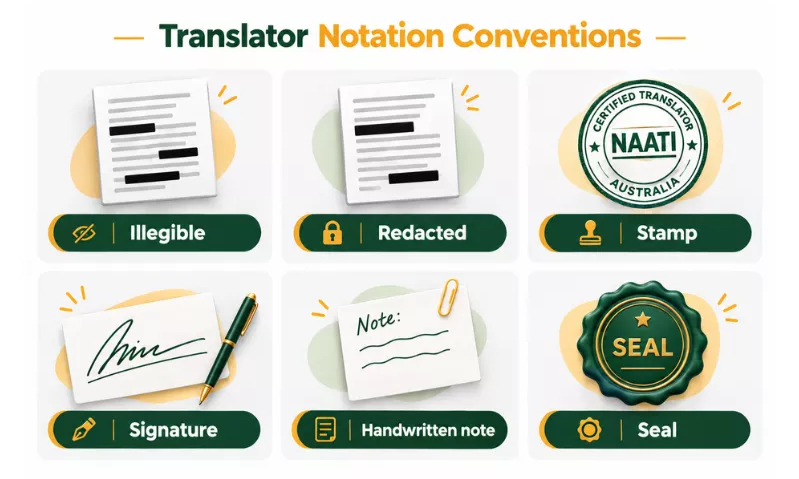
Translators account for non-textual elements, signatures, and damaged sections using standardised bracketed notations, which receiving officers rely on to read the source document’s structure
- [Illegible]: Used for text that cannot be deciphered due to the source scan’s physical damage, severe fading, or water stain.
- [Redacted]: Used where sensitive personal information is removed by the redaction before translation.
- [Stamp]: For a rubber stamp, seal, or ink on the source scan. Example: [Stamp: Ministry of Foreign Affairs Official Seal].
- [Signature]: Used in place of a handwritten signature on source forms, certificates, or contracts.
- [Handwritten note]: Used for marginalia, manual additions, or handwritten notes outside standard fields on the source scan.
- [Seal]: For official embossed, foil, or wax seals of the foreign legal or academic deeds.
Using these conventions keeps the translation compliant and reduces the risk of rejection. If you need foreign-language documents translated with strict standards, engaging a NAATI-certified translator through NAATI translation services ensures the document carries the required markings.
The Formal Certification Statement
Under Australian administrative and judicial standards, a translation lacking a formal accuracy declaration is treated as an unverifiable draft. Such documents are usually placed on hold during processing or simply fail to meet the evidentiary requirements for Australian courts.
The NAATI certification statement serves as a binding legal declaration, and by signing it, the practitioner attests to their active certification. It verifies their language pair and guarantees that the English output represents a complete, true, and faithful rendering of the non-English source document.
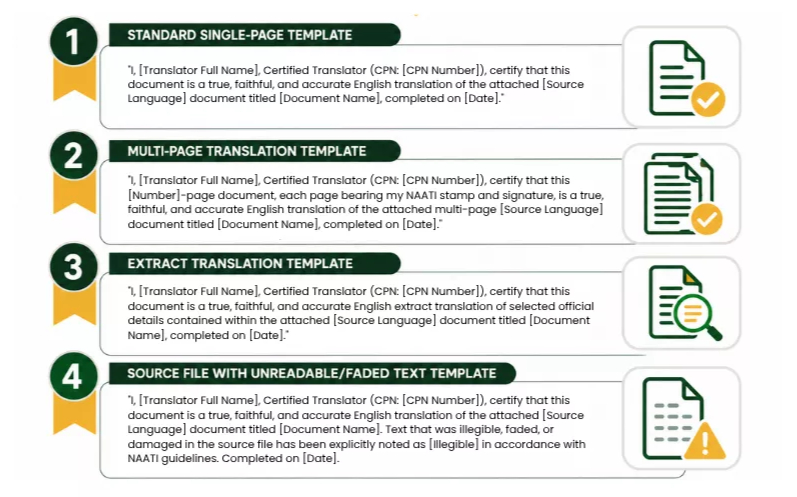
To maintain strict regulatory compliance across different lodgement scenarios, tailor the statement to the document’s structure and the source’s physical condition.
Layout & Submission Formatting
Translation services in Australia adhere to strict spatial, layout, and assembly rules. This allows receiving officers at the Department of Home Affairs, DFAT, state courts, or universities to compare documents side by side.
Placement & Certification Rules
- Page-Level Certification: Every page of the translation must carry a NAATI stamp, practitioner signature, Certified Practitioner Number (CPN), and completion date.
- The Final Declaration: While individual certification markings belong on every page, the full accuracy certification statement can be present on the final page.
- Stamp & Margin Guidelines: Place stamps, signatures, and dates within margin blocks or footers so they never cover, overlap, or hide translated text.
- Sequential Footer Control: Every page footer must display strict sequential page numbering (e.g., Page 1 of 3, Page 2 of 3) to prevent uncertified pages from being inserted, omitted, or changed after delivery.
Source Document Pairing & Assembly
- Assembly Order: Submissions follow a set order: the certified English translation first, followed by scans of the source document.
- Scan Quality Standards: Provide original source files as high-resolution, full-colour, uncropped scans for digital portals like ImmiAccount. Dark, blurry, or cropped mobile photographs hide watermarks, fine print, or seals and risk immediate document rejection.
- Mirror-Layout Alignment: Tables, paragraphs, and form fields must mirror the source text’s spatial layout. Replicating exact grid structures, rather than using free-form summaries, ensures receiving case officers can instantly verify data points side by side.
Certified vs Recognised Practising: Key Differences
Understanding the visual differences on the stamp ensures your document shows the correct practitioner designation for its language classification.
Read our complete breakdown on what happens when NAATI doesn’t certify your language to ensure your rare language document remains compliant.
Certified Translator:
This credential is issued for languages with a formal NAATI testing pathway. To fulfil all NAATI certified translator requirements, the practitioner’s stamp reads “Certified Translator” and shows their Certified Practitioner Number (CPN).
Recognised Practising Translator:
This credential is issued for new and emerging languages where NAATI certification testing is not yet available. The stamp displays “Recognised Practising Translator” instead. Both stamps are accepted for official Australian submissions.
Onshore vs Offshore: What Must Be Included
For non-English documents translated within Australia, ensure an active certified translator is assigned to your file.
Receiving officers and applicants can verify NAATI-certified translation authenticity by scanning the embedded digital QR code or searching the practitioner’s CPN in the live directory.
Submitting offshore translations without the translator’s full name, contact details, and qualifications on official letterhead may lead to processing delays.
If you want to know more about regulatory requirements, explore the guide on who can translate documents for immigration australia.
Pre-Submission Checklist
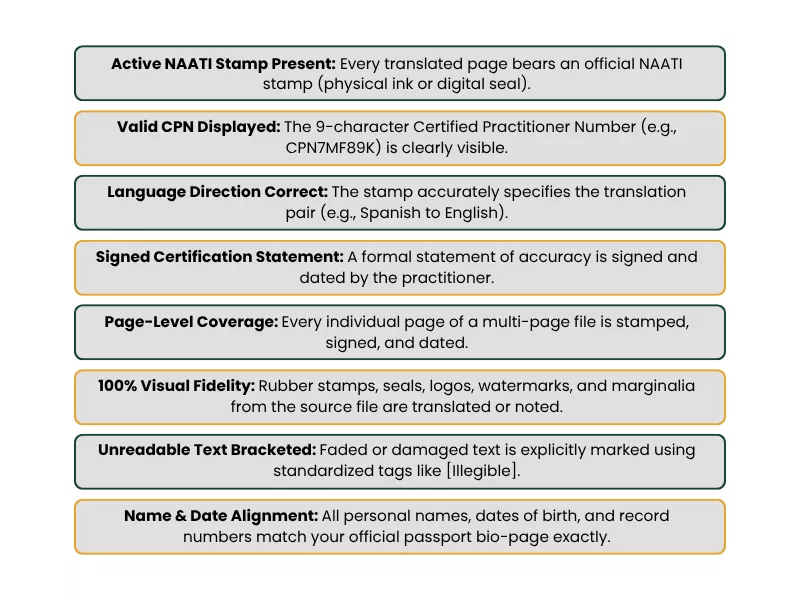
Before lodging foreign-language documents with an Australian authority, use this effective audit checklist to confirm your file follows the required NAATI translation format and complies with Home Affairs visual standards.
Final Checks Before You Lodge
Submitting an uncertified or incorrectly formatted translation to an Australian authority leads to administrative delays or document rejection. Valid practitioner credentials, a completed certification statement, and a layout that replicates the source are crucial to avoid additional delays in processing your application.

- What a Compliant Certified Translation Must Include: Stamp, CPN, & Certification Statement - September 21, 2026
- How Can a Fake Certified Translation Trigger a 3-Year Visa Ban? - September 17, 2026
- What Happens When NAATI Doesn’t Certify Your Language? - September 7, 2026
