

Certified vs. notarized translations in Australia are something you must know if you are migrating to the country. It will save you from document rejections, expensive submissions, and processing delays.
Here, we will clear the air around these and also help you understand when you should choose what, so that you don’t have a problem with the processes.
Key Takeaways: The Difference between Certified and Notarized Translation
- Certified translations verify the accuracy of translation, while notarized translations verify the identity of the translator
- Most Australian immigration, education, and government applications need certified translations
- Notarized translations are mostly needed for international legal or official use
- Certified translations are generally faster, cheaper, and required more commonly
- It is necessary to check the receiving authority’s requirements to avoid delays or rejections
What Is a Certified Translation in Australia?
Therefore, if you need a certified translation, you must hire a NAATI translator. Once the translator completes a translation, they attach a certification statement that includes:
- Their NAATI Certification number
- A declaration that says the translation is true and accurate
- Their signature and date of translation
- The language pair (source and target language)
The certification acts as a confirmation that a qualified professional, bound by the AUSIT Code of Ethics, has confirmed the accuracy of the translation. Certified translations are accepted by Australian government departments, courts, universities, and professional bodies that need official submissions.
What Is a Notarized Translation?
- Verify the identity
- Witness the signature of the translator
- Put their notarial seal and signature on the document
The notary public does not check or verify the quality of the translation, but they confirm that the person doing it is a translator, and they swear to the accuracy of their work under oath. The objective is to add legal weight to the document, thus making it acceptable for various purposes.
All notarized translations have these key components:
- The completely translated document
- The translator’s signed certificate statement
- Official seal and signature of the notary public
- A certificate confirming the authentication process
- Date and location of notarization
That helps you understand what each of these terms means and what you need to look for in each of them. The following section will answer the main question of the discussion: certified vs notarized translations in Australia.
Certified vs. Notarized Translations in Australia: The Key Differences
Here’s a look at certified translation vs notarised translation:
| Feature | Certified Translation | Notarized Translation |
| Primary Guarantee | Completeness and accuracy of the translated text | The translator’s identity and the act of signing an oath |
| Who Performs It | Qualified translators with proper credentials | Government-authorised notary public |
| Purpose | To prove that the translated piece matches the original source perfectly | To remove fraud and swear to the document’s validity before an official, legally |
| Common Uses | Academic transcripts, birth certificates, and standard immigration documents | Specific court cases, international contracts, and overseas legal proceedings |
| Cost and Time | Faster and cheaper | Requires additional costs and steps |
When Do You Need a Certified Translation in Australia?
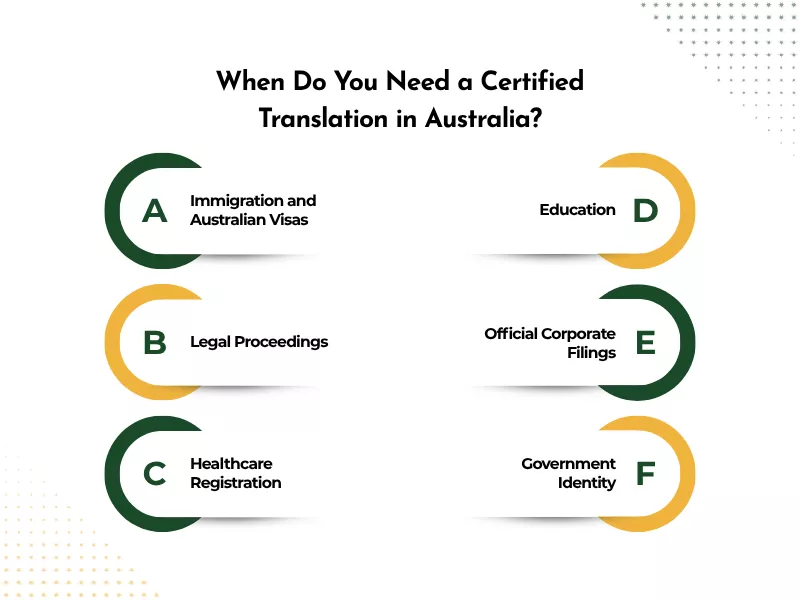
The Australian authorities ask for certified translations from individuals migrating to the country. The requirements include translating all foreign-language documents to English for official use. Document translations from a certified translator are necessary in these scenarios:
A. Immigration and Australian Visas
Any foreign document that is submitted to the Department of Home Affairs, like birth certificates, police checks, marriage certificates, passports, etc., needs translation. It is highly recommended that you avail professional translation services in Australia to get them done by a certified translator to avoid Home Affairs translation rejection.
B. Legal Proceedings
Certified translations for evidence, affidavits, witness statements, or contracts are necessary for presentation in Australian courts and in front of law enforcement bodies. Engaging a certified police report translation service ensures these official incident records are accurate and fully admissible in legal proceedings.
C. Healthcare Registration
For individuals from foreign countries applying for a medical role, the Australian Health Practitioner Regulation Agency (AHPRA) requires translated qualifications and identification to be certified by a certified translator using the proper NAATI translation format.
D. Education
The schools and universities in Australia need certified transcripts and degree certificates for assessing admission and credit transfers. The professional translation services can help translate these documents as per the Australian document translation requirements.
E. Official Corporate Filings
Certification of foreign business documents is a mandatory requirement set by the Australian Securities and Investment Commission (ASIC).
F. Government Identity
Individuals must provide certified translations for driver’s licence translations or for any Department of Home Affairs processes.
When Do You Need a Notarized Translation in Australia?
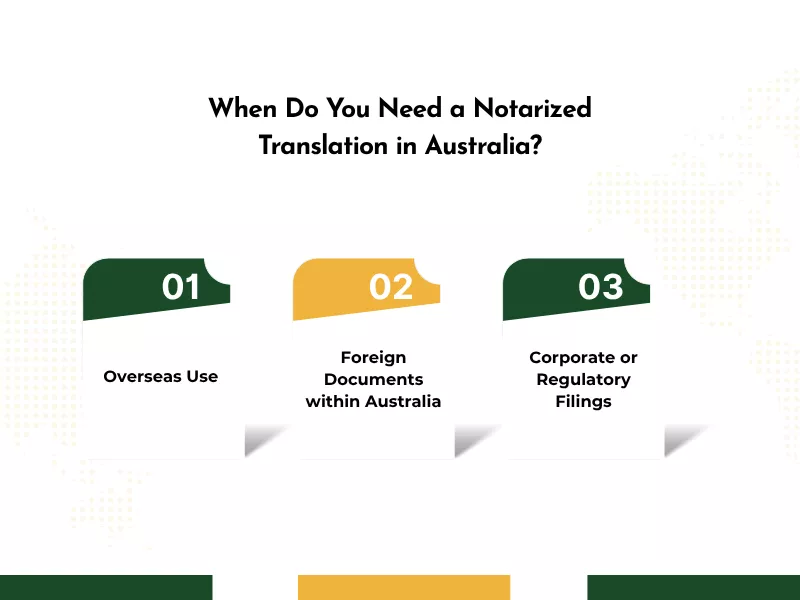
A. Overseas Use
In cases where you need to submit Australian documents to foreign authorities, like getting married abroad, buying property overseas, or applying for foreign visas, the receiving authorities might ask for a notary verification.
B. Foreign Documents within Australia
Specific legal or court proceedings, or certain statutory bodies, may ask for notarization of the translator’s affidavit. This extra step helps ensure your foreign evidence remains admissible in Australian courts without causing procedural delays.
C. Corporate or Regulatory Filings
The financial regulators, like the ASIC, or government bodies, need independent verification for overseas regulatory documents at times. In such cases, notarization is essential.
In a nutshell, you would only require a certified translation while presenting a translated document to an Australian government body, university, or employer. Notarised translation should only be needed if the receiving entity instructs you to get one.
Understanding certified translation vs notarized translation is important for all migrating to Australia. It is highly recommended that you hire a certified translator to ensure everything is accurate and gets accepted by the authorities.
That will help you understand the differences between certified and notarisede translations.
What Are the Documents that Commonly Need Notarization for Australian Visas?
A. International Court Proceedings
When you are submitting evidence, affidavits, or court documents to foreign courts, it is mandatory to notarise all those translated documents before submission.
B. Foreign Immigration Application
This varies from one country to another. For instance, the USCIS (United States Citizenship and Immigration Services) might accept certified translations, but they prefer notarized versions of the documents. On the other hand, in Australia, the Department of Home Affairs accepts certified translations for visa and immigration applications.
C. International Business Transactions
The documents that are needed in international business dealings, such as contracts and financial statements, often need notarization to make them legally compliant across borders.
D. Academic Documents for Foreign Universities
Foreign universities often ask for notarised translations of the academic documents, like transcripts and academic records, to consider them authentic.
The Translation Notarization Process: How It’s Done?
A. Find a Certified Translation Service
The first step is to find a translation service provider that has a team of certified translators to translate your birth certificate or any other document. The translator will do the translation and attach a certification statement along with the translated document.
B. Prepare the Notarization Document
In cases where you need both certified and notarised translations, you must collect the following documents:
- The original document in the source language
- The certified translation
- The certification statement of the translator
- The translator’s valid identification
C. Schedule an Appointment with a Notary Public
It is necessary for the translator to appear before the notary public to get the document verified.
D. The Notarization Process
On the day of the appointment, in front of the Notary Public, the translator will:
- Provide valid identification to the notary
- Review the certification statement
- Swear an oath and confirm the accuracy of the translation
- Sign the certification statement in the presence of the notary
E. Get Your Notarized Translation
As soon as the process is complete, you will get the notarised and certified translation that you can submit to the foreign authorities.
Understanding the Country-Specific Requirements for Notarisation
A. Australia
- The Department of Home Affairs accepts certified translations by NAATI recognised translator
- Notarization is necessary when you are submitting Australian documents to foreign authorities
- Notarisation might be necessary for court or legal documents translation, court proceedings, depending on the case type
- Certified translations are accepted by universities and educational institutions
B. United States
- Certified translations are accepted by the USCIS, carrying the certification statement of the translator
- While notarization is not a mandate, it is highly recommended
- The translation must have the translator’s contact information and qualifications
C. United Kingdom
- Certified translations are generally enough
- Notarisation is necessary in case of legal proceedings
- A few documents need Foreign and Commonwealth Office Legalisation
D. Canada
- The country accepts certified translations from certified translators
- Notarisation might be necessary for Quebec submissions
- A few provinces in the country have specific translator requirements
E. European Union Countries
- Most of the EU countries need notarised or sworn translations
- For non-EU countries, an apostille is generally a mandate
- Each of the EU countries might have specific translation certification requirements
F. China
- The country needs notarization along with Chinese embassy authentication
- All documents must be apostilled (if it is from a Hague Convention country)
- The original and translated document both needs authentication
G. New Zealand
- The requirements are similar to those in Australia, and accept certified translator certifications
- Notarization is crucial for court documents
- In some cases, cross-recognition with the Australian NAATI is acceptable
To End with,
Professional translators assess translation quality and ensure that the translation is accompanied by a certification statement. However, the notary public is not responsible for checking the quality, but witnesses the translator translating the document. Find the right service provider that can help you both so that you can get assistance with certified and notarised translations.
Frequently Asked Questions
Do I need a certified or notarized translation for Australian immigration?
You will need a certified translation for Australian immigration. In this case, you will not need a notarized translation.
Can a notarized translation be used instead of a certified translation?
Generally, no. Notarised translations cannot replace a certified translation if the concerned authority asks for a certified one.
Does a notarized translator need professional certification?
Yes, a notarized translator needs professional certification. While the Notary Public only verifies the identity of the person, the service providers offering the services have certified translators for handling all translation requirements.
When do I need both certified and notarized translations?
You will need both certified and notarized translations when a receiving authority needs an official guarantee of accuracy, along with a legal verification of the translator’s identity.
What is a notarized affidavit translation?
A notarized affidavit translation combines document translation with a legally binding sworn statement. In this process, the translator adds an affidavit (sworn declaration) to the translated document, which acts as a confirmation of accuracy, and the translator signs it in presence of the Notary Public.
Can I translate a document and get it verified?
No, you cannot translate and certify the translation by yourself. In Australia, only a certified translator can translate and certify official documents.

Want To See My Profile — Click Here Michael Brown
- Document Translation Guide for Migration Agents - September 4, 2026
- Why Do Different Australian Authorities Accept Different Translations of the Same Document? - August 28, 2026
- What Makes a Translated Document Admissible in Australian Courts? - August 17, 2026
