
When do you need certified translation or standard translation completely depends on the purpose of the document and the requirements set by the authorities. That said, it is important for all to understand how these are different from one another. It will not only help you find the right direction, but it will also save you from costly delays or legal complications.
Certified vs standard translation has been a topic of interest for many, especially for those who are planning to migrate to a foreign country for education or work purposes. This blog will help you understand the differences between them, along with the meaning of each.
Key Takeaways
- Use accredited translation for official purposes (legal, immigration, academic) — includes a signed accuracy certificate and is legally valid.
- Use standard translation for informal use (emails, websites, marketing) — no certification needed.
- Key differences: certified = more expensive, slower, credentialed; standard = cheaper, faster.
- In Australia, official documents must be certified (often by accredited translators).
- Choosing the wrong type can cause delays or rejection.
What Is a Certified or Accredited Translation?
Accredited translation is an official, accurate translation accompanied by a signed statement (Certificate of Accuracy) from the translator or agency, affirming it is a true translation of the original document.
For example, a birth certificate translation needs to be certified since the document is required by the Department of Home Affairs for immigration and visa purposes.
What Is Standard Translation?
Standard translation can be defined as the process of converting written content from one language to another without any formal certification. This type of translation is mostly used for general business documents, marketing materials, website content, personal letters, and informal communication.
Certified vs Standard Translation: What Is the Difference?
The answer to when you need it lies in the differences between the two types of translation. Therefore, without further ado, let’s take you through the differences between them:
| Aspect | Accredited Translation | Standard Translation |
| Translator Credentials | The translator must have specific credentials | Translators, though professionals, do not require separate credentials. |
| Cost | Translations are expensive | Translations are comparatively cheaper |
| Turnaround | Takes longer to complete | Generally quicker |
For immigrants, accredited translations of official documents are important. For Australia, you must hire a NAATI translator to get your documents translated and certified for official purposes.
In the case of translating product brochures, website content, user manuals, internet emails, articles, etc., standard translations can be useful.
You must understand the translation requirements and the reason for selecting the type of translation. It is highly recommended that you avail translation services Australia to get the translations done correctly.
While that helps, it is important to know the ‘when’ in detail. Therefore, to ensure you are well-versed in it, let’s answer that question with respect to both certified and standard translation one by one.
When Is Accredited Translation Required in Australia?
If you ever wondered, why was my translation rejected? Then you might have submitted the wrong type of translation.
These translations are mostly needed for official purposes in Australia. The country only accepts accredited translations for official and administrative uses.
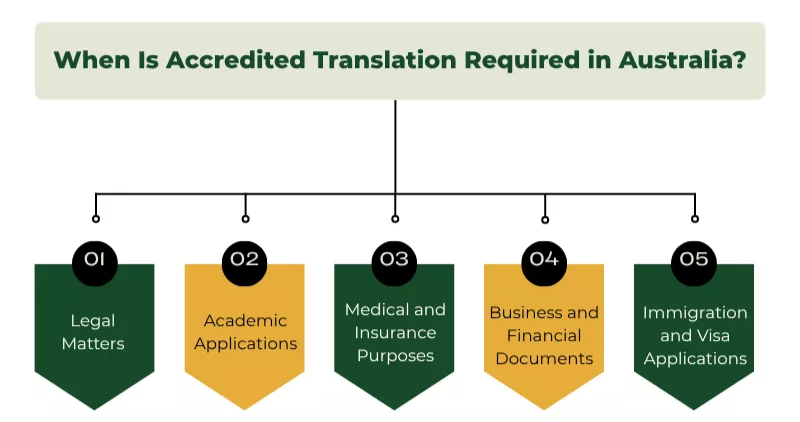
Here are a few scenarios where this type of translation is needed:
A. Legal Matters
All legal documents need to be translated and certified to be accepted by courts in Australia. Individuals with documents from foreign countries handling legal matters will need to translate the documents and get them certified before placing them in court. For example, a marriage certificate translation needs to be certified for a successful application in Australia.
B. Academic Applications
Students willing to get admission to educational institutions in Australia from foreign countries must ensure all their documents are in English. For those whose documents are not in English, it is necessary to translate academic transcripts, degrees, and diplomas, and get them certified for a smooth process. If your test or credential evaluation requires re-assessment, read our NAATI test review process explained guide before submitting your application.
C. Medical and Insurance Purposes
Certified medical report translation can save you time if you are willing to travel to Australia for medical purposes or need immediate medical assistance.
D. Business and Financial Documents
It is crucial to hire an accredited translator if you want a trade certificate translation. This is to ensure that the translation is accurate, precise, and matches the standard set by the government. Availing accredited translation services ensures that, accompanied by a formal NAATI certification statement confirming the translation as an accurate representation of the original record.
E. Immigration and Visa Applications
The Australian authorities only accept accredited translations for visas, passports, birth certificates, and other documents for immigration, residency, and citizenship applications. Therefore, it is necessary to hire a migration translator approved by NAATI to translate your documents. If you’re relocating or applying for a visa, a certified passport translation service ensures this key travel document is accepted without delay.
When Is Standard Translation Required in Australia?
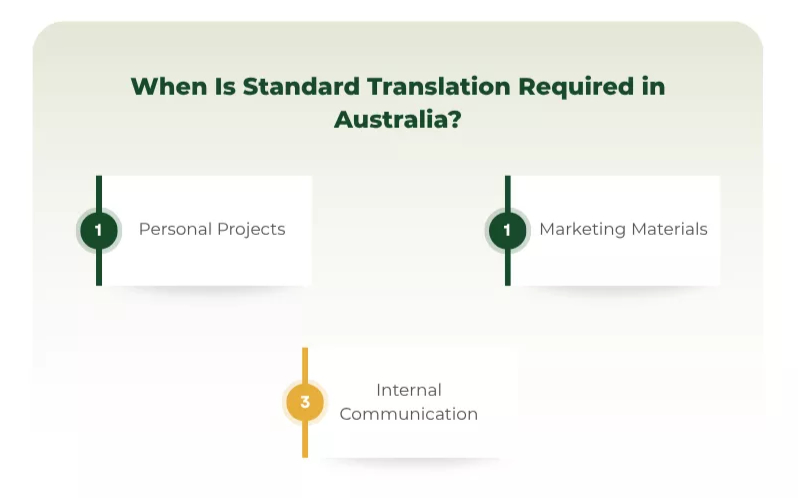
You will require standard translations for different purposes in Australia. These include:
A. Personal Projects
In case you are translating documents for your personal understanding or informal sharing, like letters, emails, or general information, you can use standard translations.
B. Marketing Materials
You can opt for standard marketing translation if you want to translate brochures, advertisements, websites, and other marketing content. Since these are for internal use, standard translations can be enough. However, in the case of legal translation requirements for businesses, you will need certification of translations.
C. Internal Communication
Standard translations are sufficient for employee handbooks, memos, or training documents. You will need these for internal communication.
While these do not require certifications, you must avail standard translation services to ensure accuracy.
How to Get Accurate Translations in Australia?
It is necessary to find the right service provider to get both certified and standard translation in Australia. These are a few things you need to check to find the right service provider:
- It is necessary to check if the service provider is available 24/7 via phone, WhatsApp, email, or live chat to address your requirements at any time.
- Ask for prices from multiple websites before choosing one. Further, the price needs to be free and non-binding.
- Check for testimonials and reviews on various third-party websites to understand the quality of their work. It is also necessary to ask for samples.
AustralianTranslationServices is one of the trusted translation service providers in Australia. You can share your requirements for extract vs full translation for immigration documents to get a price quote and place an order accordingly.
To End with,
Translations play a crucial role in various aspects. For people travelling to Australia or businesses expanding globally, translations are necessary for all. However, it is necessary to understand the differences between certified and standard translations and opt for the right one when needed.
Find the right service provider, check for the services they offer, the prices, their customer support, and all other things before you place an order.
Frequently Asked Questions
Is an accredited translation legally valid?
Yes, government agencies, courts, and immigration authorities across Australia legally accept valid accredited translations. Standard translations, by contrast, carry no such legal standing.
Is standard translation accepted for official documents?
No, standard translations are not legally valid for official purposes in Australia. These are only suitable for personal use, internal business communication, or general content.
How do I know which type of translation I need?
If you are submitting a document to any official body, you need a certification of translation — and because different Australian authorities accept different translations, confirm the exact format that body expects before ordering. On the other hand, if the translation is for personal reference, internal business use, or general communication, a standard translation is fine.
Do Australian universities require translations of transcripts to be certified?
Generally, yes. Numerous universities ask students to provide a translated and certified transcript upon admission.
How long does an accredited translation take in Australia?
The time depends on the urgency and complexity of the documents. Generally, it takes around 3-5 business days for common documents, with express delivery taking around 24-48 hours.
What documents need an accredited translation for Australian immigration?
Any non-English document submitted to the Department of Home Affairs must be certified. These include birth certificates, marriage and divorce certificates, passports, police clearance, and all such official documents.
