
Ever wondered why was my foreign driver’s license rejected for official paperwork? Most overseas driver’s licences are rejected with Australian visa applications for one of three reasons: the translation isn’t certified, the name or date of birth doesn’t match the applicant’s passport, or critical details from the back of the card are missing. The fix is almost always the same: an accredited translation that exactly matches your passport details.
Therefore, let’s check out the 5 most common overseas driver’s licence rejection reasons.
Key Takeaways: Why Was My Overseas Driver’s License Not Accepted with Visa Paperwork?
- Most overseas driver’s licence rejections come down to translation problems, not document problems.
- Australian authorities require a certified English translation; an International Driving Permit alone is rarely enough.
- The translation must include the back of the licence and match passport details exactly.
- Name formatting, date format, and missing translator credentials are the most common rejection triggers.
- If you’ve been rejected, you can resubmit with a corrected certified translation and a cover letter.
The 5 Most Common Overseas Driver’s Licence Rejection Reasons for Visa Paperwork
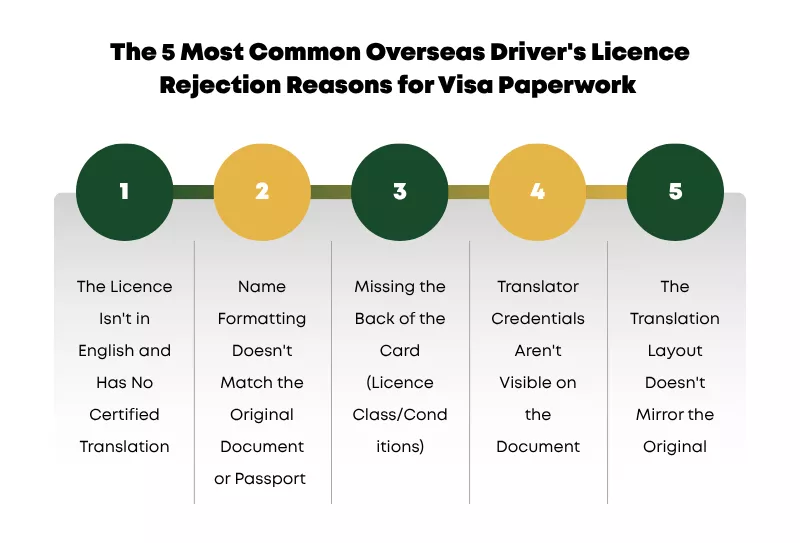
An overseas driving licence is mostly rejected because of 5 common reasons. Here are the rejection reasons with explanations:
The Licence Isn’t in English and Has No Certified Translation
Can a foreign driver’s licence be accepted if it is not in English? No, not on its own. Australian authorities require either a certified English Driver Licence Translation alongside the original, or, in limited cases, an International Driving Permit. Without one of these, your licence will be rejected at lodgement.
What Problems Can Happen If a Translation Is Not Certified for a Visa Application?
- Document Rejection: Authorities dismiss non-certified translations outright, as they miss required statements of accuracy, stamps, or credentials from bodies.
- Application Delays: Processing halts until resubmission with proper translations, potentially adding weeks or months.
- Visa Refusal Risk: Inconsistencies or perceived inaccuracies can trigger fraud flags (e.g., Australia’s PIC 4020), leading to outright denial.
Name Formatting Doesn’t Match the Original Document or Passport
Can a License Translation Be Rejected because of Name Formatting? The answer is resounding yes!
If your name formatting in the translation does not not match the original document closely enough or does not appear clear, it will be rejected. Furthermore, if your name formatting does not match the passport, then it will be rejected. Therefore, when translating a restricted or provisional driver’s licence.
Common issues include shortened names, reordered name parts, missing middle names, inconsistent spelling, or different spacing/hyphenation from the original licence or passport.
Missing the Back of the Card (Licence Class/Conditions)
The Australian authorities want the full document, not just the front, so a partial translation may be treated as incomplete. Common missing details include licence class, glasses/contact-lens conditions, vehicle restrictions, and other notes printed on the reverse side. This can delay or derail a licence conversion or roadside verification if the officer cannot see the full entitlement information.
Translator Credentials Aren’t Visible on the Document
Australian authorities expect the translation to show who translated it and to make the translator’s certification easy to verify. If the credentials are missing or unreadable, the document may be treated as incomplete or not officially accepted. That can delay getting an International Driving Permit (IDP) vs a translated license, roadside checks, insurance processing, or rental approval.
The Translation Layout Doesn’t Mirror the Original
If your translated version does not match the layout of the original, it will be rejected. Translation of a driver’s license can improve your travel experience only if you avoid common mistakes like missing sections, reordering details in a way that confuses class or condition information, or leaving out the back of the card. Furthermore, if the layout hides key items like licence classes, restrictions, expiry dates, or endorsements, the document may be treated as incomplete, delayed or refused.
What Home Affairs and State Road Authorities Actually Require?
- Home Affairs generally wants an English translation for official settlement or visa-related use when a document is not in English.
- State road authorities usually want the original overseas licence plus an official English translation that they accept for licensing or conversion.
Department of Home Affairs Document Standards
- The translation should be accurate, complete, and readable.
- It should preserve key identity and licence details exactly as shown on the original.
- Where a translation is required for official purposes, it should be prepared by an accepted, professional NAATI translator.
State-level Requirements (VicRoads, Transport for NSW, QLD TMR, Service SA, WA DoT)
- Requirements vary by state, but they generally expect an official English translation.
- The translation must clearly show licence class, expiry date, conditions, and other relevant endorsements.
- Some authorities mandate having a certified translation or another accepted equivalent.
Therefore, you must search for a reliable and trustworthy translation service Australia.
What Makes It Valid for Official Use?
- It must be accurate and complete.
- It must be issued by a translator or a service accepted by the relevant authority.
- It must match the original document closely enough for officials to verify identity and licence entitlement.
Why Is It Required for Official Submissions?
- Officials need to understand the licence details in English.
- It helps them verify identity, driving entitlement, restrictions, and eligibility.
- It reduces errors and delays in processing applications.
Why Do Authorities Require an English Version of a Driver’s License?
- English is the standard working language for most Australian government processing.
- Officials need a single readable version for verification and record-keeping.
- It avoids misunderstandings about licence class, conditions, and validity.
How Can a Non-English Driver’s License Be Used for an Application?
A non-English licence requires a certified translation of the licence for an application.
What Documents Are Usually Needed with a Translation for a Visa Application?
For a visa application, when you present the translation to authorities (such as a transport department or police), it must be accompanied by the following documents:
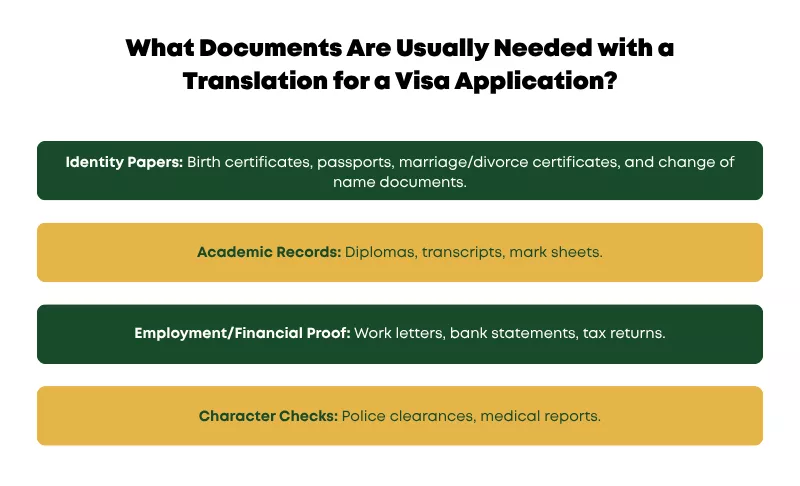
Please note: If these documents are in a foreign language, you will need to go for document translations.
How to Make Sure a Driving License Translation Matches Your Passport Details?
To make sure your translation of the driving licence matches the passport, use the passport spelling as the reference name, and keep it consistent across every document submitted for the same application.
When getting the translation done, inform the translator to maintain the spelling of the passport document. Furthermore, after getting the translation, check the spellings, surname, given names, middle names, hyphens, apostrophes, spacing, and any accents or transliteration variants.
So, if you are concerned about what to do if your passport and licence already disagree, check properly and get it fixed before submitting to the authorities.
What Causes Name Mismatches between a Driver’s License and Passport?
- Different transliteration from a non-Latin script into English.
- Marriage, divorce, or legal name change on one document but not the other.
- Typos, shortened names, initials, or reordered name parts on one ID.
- Different cultural naming conventions, such as patronymics or double surnames.
What Should Match Exactly in a Translation for Identity Checks?
- Full name spelling, including order of names.
- Date of birth.
- Licence number and other document identifiers.
- Issue and expiry dates.
- Any restrictions, endorsements, or conditions that affect identity or driving entitlement.
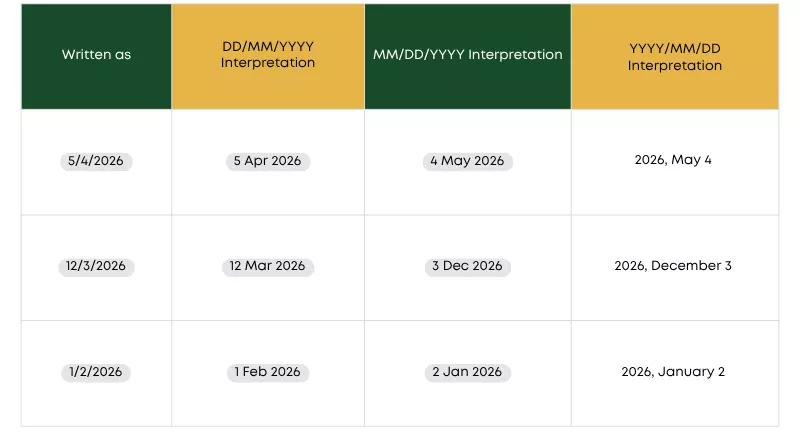
Date Format Conventions (DD/MM/YYYY vs MM/DD/YYYY)
In Australia, the standard format is DD/MM/YYYY. However, not every country follows the same. Furthermore, countries like China, Japan, South Korea, Mongolia, and Taiwan use YYYY/MM/DD.
Therefore, hiring a professional translator is essential because they maintain proper structure. Whether you get a Chinese translation or another language translation, a translator with proper certification holds knowledge of both the source and target languages.
How Do I Fix Personal Detail Mismatches across Identity Documents?
To fix the mismatch, compare the documents properly. If you find a mismatch in the original documents, contact your concerned authorities in the country and get them fixed. Once all documents match information properly, translate them.