
In Australia, the federal courts require all foreign-language documents, such as a birth certificate, contract, affidavit, or any other document, to be translated into English. However, you cannot submit any translation; you will need to submit a trusted translation, which is accurate and complete as per the specific legal meaning.
This article sets out exactly what Australian courts require, why the requirements exist, and how to make sure your document doesn’t get rejected at the worst possible moment.
Let’s understand what makes a translated document admissible in Australian courts.
Key Takeaways: Translated Document Admissible in Australian Courts
- A certified translator is generally the safest choice, and their certification must be current.
- Submit the complete foreign-language document together with its accurate and complete English translation.
- Courts such as the Federal Circuit and Family Court may require an affidavit confirming the translation’s accuracy and the translator’s qualifications.
- Rules of admissible translated documents differ between federal courts, state and territory courts, and tribunals, so check the relevant rules, practice notes or registry requirements before filing.
- The opposing party may question the translation, the translator’s credentials or particular wording, so use an experienced translator and complete the verification process well before the hearing.
What Type of Translated Document Is Admissible in Australian Courts?
An Australian court will generally only accept a foreign-language legal document as evidence if it is accompanied by:
- A translation prepared by a NAATI-certified translator (or, in limited cases, a court-appointed or otherwise qualified interpreter/translator).
- An affidavit from the translator verifying the translation is accurate and setting out their qualifications to make it.
- The original foreign-language document, so the court and other parties can check the translation against the source.
Get any one of these wrong, and you risk the document, and potentially the argument that depends on it, being excluded.
What Are the Rules for Submitting a Foreign-language Document as Evidence in an Australian Court?
Litigation runs on the accuracy of the evidence in front of the judge. A mistranslated clause in a contract, a misdated event in a police report translation, or a subtly altered meaning in a witness statement can change the outcome of a case.
Since the court’s judgement depends on the accuracy of the evidence produced, accurate and precise legal translations are required.
This is why most courts in Australia depend on both interpreters (who convert spoken language in real time) and a translator (who converts written text). So, if something goes wrong in the trial because of the misinterpretation or mistranslation, there is a real person who can be cross-examined about it.
Here are the rules one needs to follow for submitting a foreign language document as evidence.
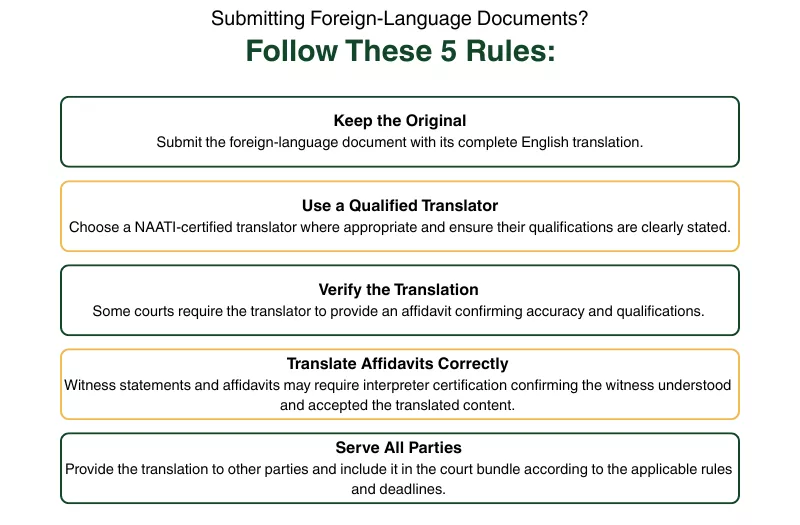
Keep the Original Document
File or tender the foreign-language document together with the complete English translation. Do not submit only an informal translation or summary unless the court permits it.
Use a Qualified Translator
A certified translator by NAATI is generally the safest choice and will save you from triggering a 3-year visa ban because of fake certified translations. The translator should identify their qualifications and certify that the translation is accurate and complete. The Federal Court defines a certified interpreter as someone currently certified by NAATI, although the Court may accept another person who proves they are suitably qualified.
Verify Where Required
In the Federal Circuit and Family Court of Australia, a non-English document that must be filed must be accompanied by:
- an English translation; and
- an affidavit from the translator verifying the translation and stating the translator’s qualifications.
Translate Affidavits and Witness Statements Properly
In Federal Court proceedings, a translated affidavit or witness statement from a witness requiring an interpreter generally cannot be relied on unless a qualified interpreter certifies or separately verifies by affidavit that:
- they read and accepted the interpreter Code of Conduct, such as the AUSIT Code of Ethics;
- they had adequate preparation time;
- they translated the entire document to the witness;
- the witness understood and agreed with its contents; and
- the witness swore, affirmed or signed it in the interpreter’s presence.
Give the Other Parties Access to the Translation
The translation should be served and included in the court bundle in the format and by the deadline required by the applicable rules or court orders.
Do Australian Courts Require a Certified Translator for Translated Evidence?
Yes. Courts, tribunals, government departments, and most professional bodies will not accept a translation unless it comes from a certified practitioner.
But before you hire any certified translator, here are a few practical points worth knowing:
- A Certified Specialist Translator is the higher tier, generally used for highly technical or specialised material such as complex medical or engineering translations.
- Since the 2018 changes, credentials must be renewed roughly every three years, alongside ongoing professional development. Therefore, you must check that whoever translates your document currently holds an active credential, not one that expired years ago.
- A translation agency can coordinate the work, but it’s the named translator’s personal NAATI number that gives the document its standing. Therefore, a translated document to be admissible at court must include the translator’s stamp, signature, and NAATI certification number directly on the translated document.
Does Every Foreign-language Document Need a Certified Translation, Even Minor Ones?
Generally, yes. Courts and tribunals do not consider any document “important” or “minor.” Therefore, any foreign-language material that you need to submit as evidence in court needs a compliant translation to be considered at all.
How Do I Prepare a Translated Annexure for an Affidavit in the Federal Court of Australia?
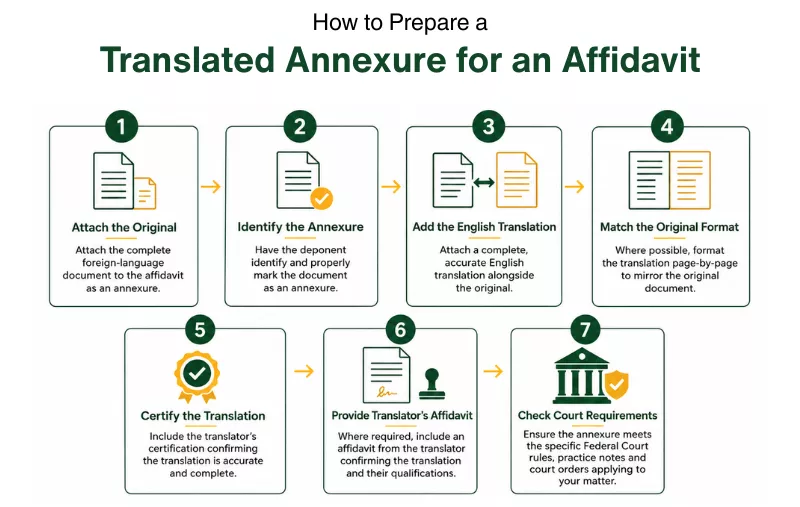
The foreign-language document should be attached as an annexure to the affidavit in the usual way (identified by the deponent and marked accordingly), with the certified English translation attached alongside it.
Ideally, the translated document must be formatted to mirror the original document page by page. The translator’s certification and, where required, their own supporting affidavit as to accuracy and qualifications should accompany the annexure so the chain of verification is clear on the face of the document.
Please note that this affidavit requirement comes directly from court rules rather than being an optional extra.
For example, the Federal Circuit and Family Court of Australia (Family Law) Rules 2021 (rule 2.17) require that any document not in English be accompanied by both a translation and an affidavit from the person who translated. This is for verifying it and setting out their qualifications. The Federal Court applies a similar logic through its practice notes on working with interpreters and on foreign judgments, which require translations of non-English material to be authenticated by affidavit.
Will an Australian Court Accept a Translation That Was Done Overseas?
Generally, not on its own.
Translations used in Australian proceedings are expected to come from a currently certified translator. If a document was translated overseas by a translator without NAATI certification, the safer approach is either to have it re-translated by a certified practitioner in Australia, or to check with the specific court whether it will accept the original translation supported by an affidavit establishing the overseas translator’s qualifications.
This is broadly consistent with the approach Australian embassies and consulates take for documents translated abroad, where a locally approved translator is usually required.
Can the Other Side Challenge the Accuracy of My Translated Document in Court?
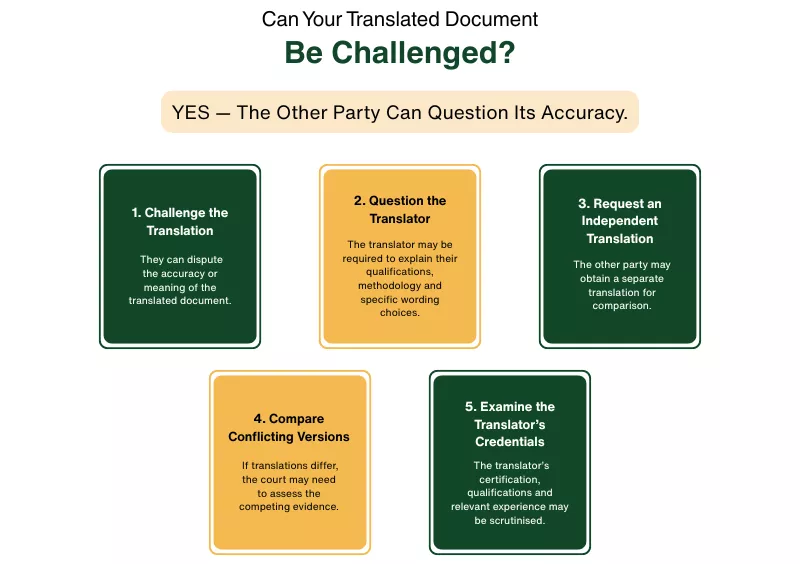
Yes. If you tender a translated document as evidence, the other party isn’t required to just accept your translator’s word for it. They can challenge it in a few ways:
What If the Other Party Disputes the Accuracy of a Translation?
The translator may be required to give evidence, or the court may order an independent translation for comparison. This is one of the practical reasons to use an experienced, appropriately credentialed translator or reach out to a reputable translation service provider in Australia, as it reduces the risk of a costly dispute over accuracy later.
Request the Translator’s Availability for Cross-examination
Since the translator has sworn an affidavit vouching for the translation, they can be called to answer questions about their qualifications and how they arrived at particular wording.
Seek an Independent Translation for Comparison
The other side can commission their own certified translator to produce a competing version, and if the two translations conflict, the court has to weigh which one it accepts (sometimes hearing evidence from both translators).
Attack the Translator’s Credentials
Checking whether their certification was current at the time of translation, or whether they were qualified in the relevant specialisation.
If a real dispute arises, it can genuinely slow things down. The Australian court may need to resolve a “battle of the translations” before it can even get to the substantive issue the document was meant to prove. That’s disruptive and costly, especially if it surfaces close to a hearing date.
The practical takeaway, and the reason this point is worth including in the guide, is that the way to avoid this risk is prevention, not defence.
Therefore, always use an experienced, currently certified translator with relevant subject-matter familiarity from the outset. This not only ensures the translation is complete and precisely formatted against the original but also gives you a chance to provide the affidavit properly executed. That doesn’t make a challenge impossible, but it makes a successful one far less likely, and gives you a credible witness to rely on if one does happen.
Do These Requirements Apply to Interpreters Giving Spoken Evidence Too?
Yes, in a parallel way. Interpreters assisting witnesses in court are separately expected to be suitably qualified and to affirm they will interpret accurately, but that is a distinct process from translating written documents for use as exhibits.
Court and Tribunal-specific Requirements
While the underlying principle, certified translation plus verifying affidavit, is consistent, the fine print varies by jurisdiction:
- Federal Court of Australia: Governed by the Federal Court Rules and supporting practice notes (including the Working with Interpreters Practice Note and the Foreign Judgments Practice Note). Foreign-language judgments and evidentiary documents generally require an authenticating affidavit alongside the translation.
- Federal Circuit and Family Court of Australia: Rule 2.17 of the Family Law Rules specifically requires a translation and a verifying affidavit for any document not in English, which is especially relevant in matters involving overseas marriage certificates, divorce documents, or parenting evidence.
- State and territory Supreme, District, and Local Courts: These generally apply the Evidence Act 1995 (Cth/NSW) or their state’s equivalent uniform evidence law, alongside their own practice directions. The evidentiary principle is the same — a party seeking to rely on a foreign-language document must produce a certified translation and be ready to prove its accuracy if challenged.
- Tribunals such as VCAT, NCAT, SACAT, QCAT, and ACAT: these bodies also expect certified translations of any foreign-language evidence tendered, and untranslated or informally translated documents are typically not admitted at all.
Because rules differ across jurisdictions and even between individual judges’ preferences, it’s worth checking the relevant court’s current practice notes or asking your legal representative before filing, rather than assuming one court’s requirements will automatically satisfy another. Machine output fails this standard before jurisdiction even comes into it — What Does Google Translate Actually Get Wrong on Official Documents? explains what breaks.
Is a Certified Translation for Immigration the Same as One Accepted by a Court?
Not always. Several reports point out that this is one of the most common points of confusion. The two systems share a baseline requirement (NAATI certification) but diverge from there, and the same pattern holds more broadly: different Australian authorities accept different translations depending on how the document will be used.
|
Aspect |
Immigration applications |
Australian court proceedings |
|
Typical requirement |
The Department of Home Affairs generally accepts a standard certified translation on its own. |
Many Australian courts, particularly the Federal Circuit and Family Court, may require a certified translation plus a separate sworn affidavit from the translator. |
|
Documents required |
The translated document should include the translator’s certification statement, number, stamp and signature. |
The translated document should include the usual certification details, together with an affidavit verifying the translation. |
|
Is an affidavit usually required? |
No. An additional affidavit is generally not required for visa or citizenship applications. |
Often yes. Under rule 2.17 of the Family Law Rules, the translator may need to swear an affidavit confirming the accuracy of the translation and explaining their qualifications. |
|
Why the requirements differ |
Immigration decisions are primarily administrative and usually do not involve cross-examination or detailed evidentiary challenges. |
Court proceedings involve formal evidence rules, scrutiny and the possibility of cross-examination or challenges to accuracy. |
|
Purpose of the extra requirement |
The certification satisfies the Department’s document and translation requirements. |
The affidavit provides an additional layer of accountability and gives the court formal evidence it can rely on if the translation is disputed. |
|
Practical implication |
A translation prepared for a partner visa or citizenship application may be sufficient for immigration purposes. |
The same translation may need to be reviewed by the translator and accompanied by a sworn affidavit before it can be filed in court. |
|
Recommended action |
Submit the certified translation according to the Department of Home Affairs’ requirements. |
Confirm the specific translation and affidavit requirements with the relevant court registry before filing. Do not assume that an immigration-ready translation is automatically court-ready. |
What Happens If a Court Rejects My Translated Document on the Day of the Hearing?
This is one of the costlier ways this issue can play out, because by the hearing date your options have narrowed considerably.
There’s no time left to engage a certified translator, arrange a proper affidavit, and have it witnessed. All of which can reasonably take days, not hours, especially for less common languages.
Courts know this, which is part of why they’re unsympathetic to translation issues raised at the last minute; the expectation is that this is sorted during preparation, not fixed reactively.
The Bottom Line
Admissibility isn’t just a formality; it’s the mechanism by which Australian courts satisfy themselves that a foreign-language document says what a party claims it says. Meeting that bar consistently comes down to three things: a currently certified translator, a complete and accurate translation, and a properly executed affidavit verifying it.
Get those right from the start, and a translated document should move through the court process as smoothly as any English-language exhibit.

Want To See My Profile — Click Here Michael Brown
- Document Translation Guide for Migration Agents - September 4, 2026
- Why Do Different Australian Authorities Accept Different Translations of the Same Document? - August 28, 2026
- What Makes a Translated Document Admissible in Australian Courts? - August 17, 2026
