
You Did Everything Right, So Why Was Your Visa Application Rejected?
Imagine this. A family has spent months preparing a partner visa application. They’ve saved the funds, gathered the evidence, and carefully worked through every requirement on the checklist. Their documents are organised, their forms are complete, and their application is lodged.
Then the rejection letter arrived.
Not because they were ineligible. Not because of a background check. But because one supporting document, a birth certificate, a marriage record, a police clearance, was translated by someone who wasn’t officially recognised to do so. This clearly violates the document translation requirements!
It happens more often than most people realise.
Every year, Australian visa applications are delayed, queried, or outright refused because non-English documents were submitted without a proper certified translation. The Department of Home Affairs has clear requirements, and when those requirements aren’t met, it doesn’t matter how strong the rest of your application is.
What makes this frustrating is that the fix is straightforward. But only if you know what’s required before you lodge.
That’s exactly what this guide covers.
Whether you’re applying under a skilled migration pathway, a partner visa, an employer-sponsored visa, or a student visa, the translation requirements differ by subclass. Getting them wrong costs time, money, and in some cases, your entire application.
This 2026 guide breaks down document translation requirements subclass by subclass, so you know precisely what needs to be translated, how it needs to be certified, and what happens if it isn’t.
Key Takeaways: Document Translation Requirements for Flawless Visa Translations
- Translate all non-English documents into English before submitting.
- Use a certified translator (very important).
- Always submit both original + translated documents together.
- Make sure the translation is complete (no missing names, dates, or details).
- Each translated document must include the translator’s stamp, Signature, and Credentials & declaration
- For multi-page documents, every page must be translated.
- Ensure your name is consistent across all documents.
General Rules That Apply to All Visa Subclasses
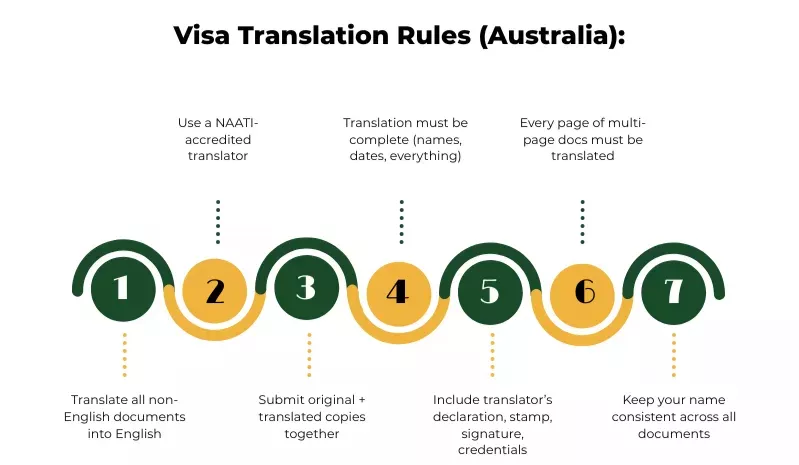
Australian authorities — Home Affairs, Australian consular services, and skills-assessing bodies such as Engineers Australia and VETASSESS — each handle their own part of a visa application, and different Australian authorities accept different translations. The general requirements are:
- You must translate all non-English documents into English, which you need to submit for a visa application.
- These translations must be done by a translator with NAATI certification.
- When you submit the documents for any subclass visa application, your original and translated documents must be submitted together.
- You will need a complete translation of the document, meaning all information, names, and dates must be translated properly.
- The translated document must have the declaration, stamp, and signature with credentials of the official translator.
- For a multi-page document, each page must be translated by the official translator.
- Whether you are applying for an Australian Work Visa, a student visa, or a skilled migration visa, your name should be consistent in all documents.
Translation Requirements for Various Australian Visa Subclasses
One of the most significant pieces of knowledge here is knowing which visa has what specifications. This will also help you communicate with the translation service Australia properly.
| Visa Category (H3) | Unique Content to Cover | Key Documents for Translation |
| Skilled 189/190/491 | For subclass 189 translation requirements, you must translate qualification docs, employment records, and skills assessments | Degree certificates, academic transcripts, professional licenses, and employment reference letters. |
| Employer-Sponsored 482/186 | The subclass 482 document translation clearly states you must translate employment contracts, payslips, and professional licenses | Prepare Financial Documents for Your Visa Application, like current and past employment contracts, recent payslips, and industry-specific certifications. |
| Partner/Family 820/309/143 | Name consistency risk, get subclass 820 visa documents translated: marriage and birth certificates | Marriage certificates, divorce decrees, de facto relationship evidence, and children’s birth certificates. |
| Student 500 | For subclass 500 student visa translation of Academic transcripts, financial statements, and enrollment docs are mandatory | High school/university transcripts, bank statements, and sponsor financial declarations. |
| Visitor 600 | When translation is/isn’t required (lightest section) | Evidence of assets, employment letters, and travel insurance (if over 75). |
| Refugee 200/202 | Incomplete document handling (most unique content) | Identity cards, family booklets, and written statements regarding missing official documentation. |
When original documents cannot be obtained, statutory declarations help fill the evidence gap by giving a formal written explanation of the missing records and the circumstances around them. They should be specific, consistent, and supported by any available secondary evidence, because they are usually treated as supplementary evidence rather than a full substitute for original identity or relationship documents.
Why Visa Subclass Matters for Document Translation?
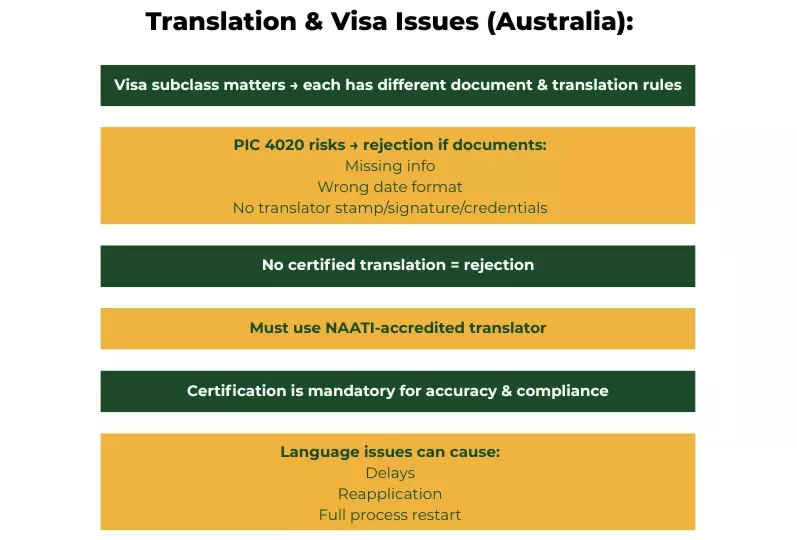
The visa subclass matters for document translation because each visa type has its own evidentiary rules, accepted document lists, and language‑validation requirements, so the same document (e.g., bank statement or degree) may need different translation treatment depending on the subclass.
What Causes Immigration Paperwork to Be Rejected Over Non-English Documents?
Under Public Interest Criterion 4020 (PIC 4020), your visa application can be rejected due to non-English documents. If your document
- Is missing information
- Has an incorrect date structure
- Does not have a certified translator’s stamp, signature, credential, or declaration.
Therefore, before you submit documents, check the visa document translation Australia 2026 requirements to avoid hassles. For this, you can connect with a migration lawyer or a firm specialising in immigration and visa applications.
What Is Public Interest Criterion 4020 (PIC 4020)?
Public Interest Criterion (PIC) 4020 is an Australian immigration regulation allowing the Department of Home Affairs to refuse a visa if an applicant provides bogus documents, false or misleading information, or fails to satisfy identity requirements. It aims to ensure integrity in the visa application process, often resulting in 3 to 10-year bans.
What Happens When Client Documents Are Filed without Certified English Translations?
For immigration, the Australian Department of Home Affairs mandates getting translations done by an official translator. In Australia, an official translator is a translator who has NAATI certification.
If an individual fails to file for sub class visa application without certified English translations for documents, it will be rejected by the authority. Therefore, every immigration agent must check NAATI translation requirements by visa type.
Can a Visa Application Be Refused Because a Translated Certificate Lacks Certification?
Yes! Translation’s certification is mandatory and essential. A certified translation Australian visa shows the translation was done by a professional who maintains accuracy and precision and is also aware of the standards set by the country.
How Can Document Language Issues Delay Migration Applications?
During immigration, the failure to provide documents translated into English by a migration translator means your application will be rejected. You will not only have to reapply but also go through the same procedure again.
What Type of Translation Is Accepted for Visa Paperwork?
Australian Government Department of Foreign Affairs and Trade
- Inside Australia: Only certified translations are accepted. (Any fake “certified” translation can trigger a 3-year visa ban)
- Outside Australia: If translating outside Australia, the translator must include their full name, address, qualifications, and a signed statement of accuracy in English.
- What to Submit: Always submit a copy of the original non-English document along with the English translation. Whether that copy is a scan or a printed original depends on the lodgement channel — Digital vs Printed Certified Translation covers the difference.
What Should Happen When Supporting Documents Are Written in Another Language?
If your documents are in any foreign language other than English, you will need to hire an official translator to translate them. Furthermore, when submitting to the authorities, you must submit both the original and translated documents.
For those wondering: Why Would Immigration Documents Be Rejected After Translation? It can be because of multiple reasons. However, immigration documents are commonly rejected after translation due to missing or improper certification, incomplete translations (skipping stamps or seals), inaccuracy, or inconsistency with original documents.
Which Documents Usually Need Translation for a Visa Application?
While you may need a lot of documents to translate for Australian visa application, you will mainly need:
-
Identity & Personal Records: A certified passport translation service is essential alongside translation of birth certificates, national ID cards, driver’s licenses, and other family documents
- Relationship Documents: Marriage certificates, divorce decrees, civil partnership documents, and death certificates of family members.
- Police Clearance & Character Documents: Securing a NAATI-certified police report translation ensures penal certificates, police checks, and criminal history records satisfy character check criteria.
- Educational & Professional Documents: Documents required to be translated to apply for a student visa are Academic transcripts, diplomas, certificates of education, and employment references
- Financial & Legal Documents: Bank statements, property records, business documents, and statutory declarations.
- Medical Documents: Vaccination certificates or medical reports.
Why Are Visa Applications Delayed When Supporting Documents Are Not in English?
Non-English supporting documents hinder verification. This is because English is the de facto national language. Furthermore, for high-volume processing, the officials do not have proper resources to interpret documents in bulk.
Therefore, they mandate translations. If you fail to provide translated documents, officials may request further information and give you a response window (often up to 28 days) to supply compliant translations. However, total processing time can vary significantly depending on the visa type and circumstances.
But this is not all; submitting an uncertified translation to the authorities has much more effect than just your visa delay. So, let’s check out the general rules for subclass visa applications.
How to Get Your Documents NAATI Certified — Step by Step
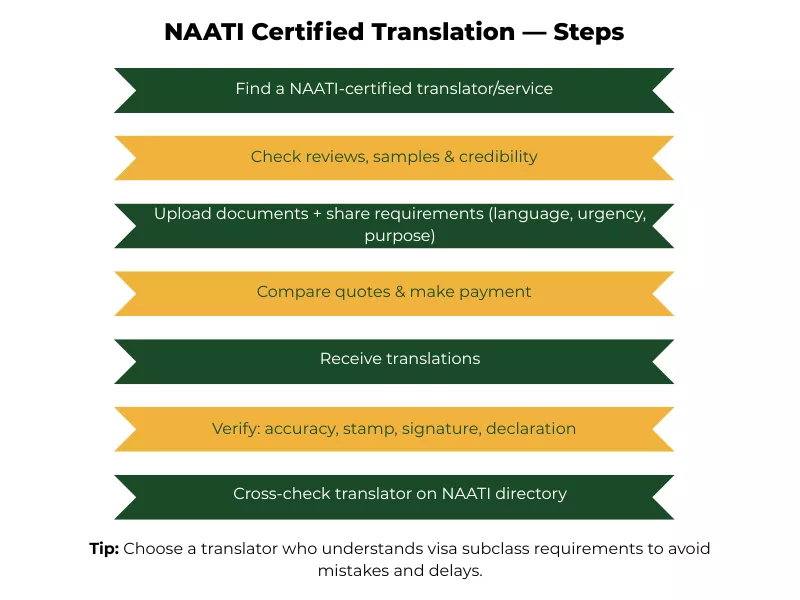
One of the significant Department of Home Affairs translation requirements is having certified translations. Here’s what you need to do:
- Search for a certified translator or a reputed translation service in Australia offering certified translations.
- Research well by checking their policies, asking for sample work, and reading testimonials on 3rd party websites.
- Upload your documents and share your requirements, like language pair, urgency, and purpose of translation. Then, compare quotes.
- Complete the payment and get your certified English translations.
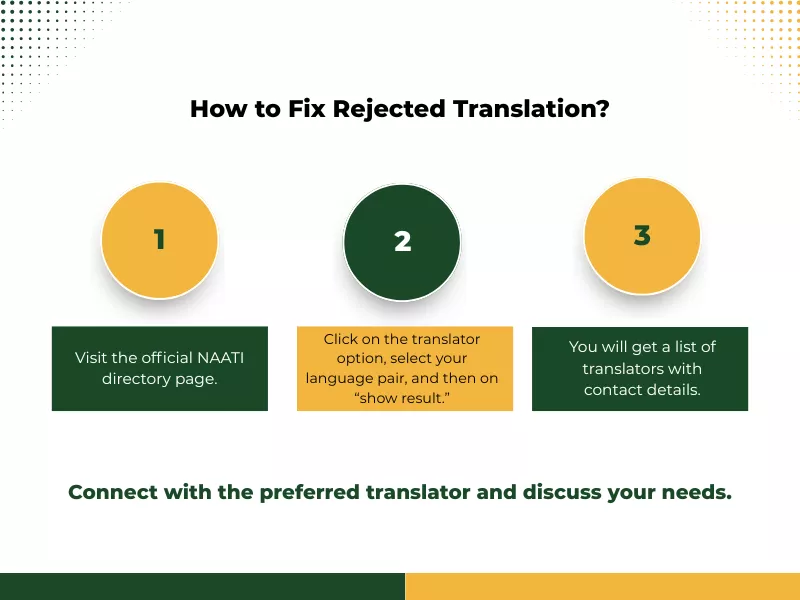
- Then check for all accuracy, signature, official stamp, and declaration. You can also verify the translator by visiting the official NAATI directory.
Dealing with document translation requirements by Australian visa subclass in 2026 is challenging. But with the right knowledge and translator, you can manage everything smoothly. Therefore, when choosing your translation partner, you must assess their knowledge about visa subclasses.
AustralianTranslationServices is a reputed service provider that works in collaboration with migration lawyers. Therefore, if you need help, reach out to us. Our team will walk you through the entire process.
Frequently Asked Questions
How can foreign-language records be made acceptable for a visa application?
You must translate the documents into English by a certified translator. Then submit both the original and translated document together to the authorities for acceptance.
Why do visa applicants use official translation services for personal records?
The Australian authorities mandate the use of an official translation service or a translator certified by NAATI for accuracy, precision, and meeting set standards. Therefore, individual visa applicants use these services for personal records.
Can certified translation services reduce immigration document rejection risk?
Yes! Having certified translations can reduce the risk of visa rejections. This is because the translators maintain the set standards of the country.

Want To See My Profile — Click Here Jack Nguyen
