
In this blog, you will explore the most interesting, amazing, and popular French sayings with their English versions.
French is regarded as an international language of the visual arts, cooking, fashion, theatre, dance, and architecture. Knowledge of the language lets you explore great French literary works, films, and songs.
The language of romance is described as smooth, elegant, flowing, and aesthetically pleasing. More than three hundred million people speak French on five major continents.
The French language is the second most widely learned foreign language and the fifth most widely spoken language globally.
French is the only language, after English, taught in almost every country of the globe. France operates as the most extensive network in the international network of cultural institutes.
So, let’s explore some of the famous French expressions and sayings in French.
Key Takeaways
- French sayings are short expressions that convey wisdom, humour, or cultural insights and are widely used in daily conversation.
- Many French idioms have direct English equivalents, making them easier for learners to understand and use.
- Expressions vary by context; some are formal and motivational, while others are informal slang or playful phrases.
- French terms have influenced global language, especially in food, art, culture, and philosophy.
- Learning common sayings improves conversational fluency and helps you sound more free, natural, and culturally aware when speaking French.
Quick Reference
| French Saying | English Equivalent | When to use it |
| C’est la vie | That’s life | Used to express resignation toward a minor disappointment. |
| La cerise sur le gâteau | The icing on the cake | Use when something good (or bad) happens on top of what was expected. |
| Battre le fer pendant qu’il est chaud | Strike while the iron is hot | Use when advising someone to take an opportunity immediately. |
| Ce n’est pas la mer à boire | It’s not a big deal | When someone is overreacting to a small task. |
| La nuit porte conseil | Sleep on it | Suggesting someone wait until morning to decide. |
| Vouloir, c’est pouvoir | Where there’s a will, there’s a way | To encourage someone to keep trying. |
| Mieux vaut tard que jamais | Better late than never | When someone arrives or finishes something late. |
| L’habit ne fait pas le moine | Don’t judge a book by its cover | Warning not to trust appearances alone. |
| Impossible n’est pas français | Nothing is impossible | To inspire confidence in a difficult situation. |
| C’est l’enfer | It’s hell / It sucks | (Slang) To complain about a bad or annoying situation. |
Top 10 General French Sayings
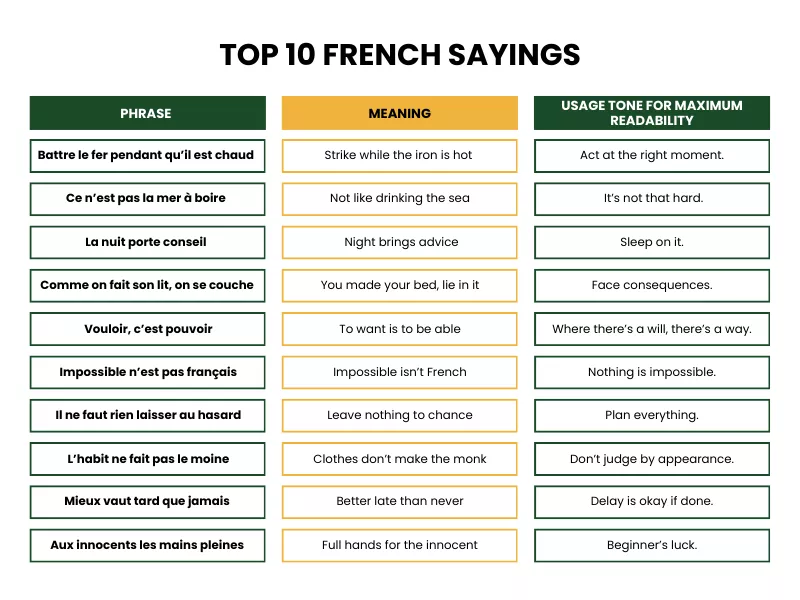
So what is French saying? A saying is a short, pithy, and commonly used expression that provides wisdom and advice for life. French people know the importance of French proverbs and common French sayings.
The famous English expression is “the apple doesn’t fall far from the tree.” That means the child possesses similar qualities to the parents. And that’s the perfect example of saying. However, most French words, when pronounced incorrectly, lose their essence.
Expressions in French are full of such witty insights as any other language. You must have heard these words often in your daily life. Let’s explore some of the most common French sayings, which, by the way, is also the official language of olympics.
Battre le fer pendant qu’il est chaud
Literal Meaning: “Strike the iron while it is hot.”
Actual Meaning: As we have the same expression in English, this is easy to understand. It literally means the blacksmith should strike the metal when it is red-hot to change its shape easily. That means we need to take advantage of favourable conditions.
- Phonetic: Ba-truh luh fehr pawn-dawn keel ay sho
- Nuance: Professional & Motivational. Safe for all settings.
- Usage Example: “The Paris market is booming right now; we should hire the best translation services in Australia to get our brochures ready. We must battre le fer pendant qu’il est chaud!”
Ce n’est pas la mer à boire
Literal Meaning: “It’s not as if you have to drink the sea.”
Actual Meaning: “Something is not that difficult” or “it’s not a big deal.” We can use these French phrases about life when someone is complaining about doing something.
- Phonetic: Suh nay pah lah mare ah bwar
- Nuance: Informal. Use with friends. Can sound dismissive in business.
- Usage Example: “If your friend is stressed about translating a one-page letter, tell them: ‘Allez, ce n’est pas la mer à boire! Just include a reliable translator, and it will be done in an hour.”
La nuit porte conseil
Literal Meaning: “The night brings advice.”
Actual Meaning: Its English equivalent can be “sleep on it.” That means taking your time before making any decision.
- Phonetic: Lah nwee port con-say
- Nuance: Neutral. Great for giving gentle advice.
- Usage Example: “Don’t rush into that merger yet. Go home, relax, and remember: la nuit porte conseil.”
Comme on fait son lit, on se couche
Literal Meaning: “You’ve made your bed; now lie on it.”
Actual Meaning: There is a funny Italian phrase: “Hai voluto la bicicletta? E adesso pedala!” That means, “You wanted the bicycle? Now ride it!”
And that’s exactly what in Italian is, Comme on fait son lit, on se couche. That’s really fascinating how different cultures have the same approach in similar situations.
- Phonetic: Kum ohn fay sohn lee, ohn suh koosh
- Nuance: Stern/Moralistic. Used when someone must face the consequences of their own actions.
- Usage Example: “He ignored the advice to get a professional review, and now the contract is invalid; as they say, comme on fait son lit, on se couche. Next time, he should hire a proper French Translator.”
Vouloir, c’est pouvoir
Literal Meaning: “To want to is to be able to.”
Actual Meaning: This is also the most common French proverb. In the English language, it means, “Where there is a will, there is a way.”
This French saying is generally used to encourage someone to do or achieve something.
- Phonetic: Vool-war, say poov-war
- Nuance: Highly motivational. Safe for all settings (school, work, or home).
- Usage Example: “I know moving your business to Paris seems daunting, but vouloir, c’est pouvoir. If you are researching how to learn French fast, starting with these idioms is a great first step.”
Impossible n’est pas français
Literal Meaning: “Impossible isn’t French.”
Actual Meaning: This expression is attributed to Napoleon Bonaparte. It can be translated as “nothing is impossible.”
It may sound very patriotic; however, “francais” here does not mean French people but the French language. As impossible is not a French term.
- Phonetic: Am-poh-see-bluh nay pah frahn-say
- Nuance: Patriotic/Inspirational. Attributed to Napoleon.
- Usage Example: “Translating 100 documents in three days is a challenge, but for a professional NAATI translation team, impossible n’est pas français.”
Il ne faut rien laisser au hasard
Literal Meaning: “Nothing should be left to chance.”
Actual Meaning: It means, “Leave nothing to chance,” or we need to plan ahead of time.
- Phonetic: Eel nuh fo ry-an lay-say oh ah-zar
- Nuance: Professional and pragmatic. Essential for project management or legal contexts.
- Usage Example: “When submitting a visa application to the embassy, il ne faut rien laisser au hasard. Ensure you have a certified NAATI translation for every single supporting document.”
L’habit ne fait pas le moine
Literal Meaning: “The outfit doesn’t make the monk.”
Actual Meaning: Its English equivalent can be, “don’t judge a book by its cover” or “don’t judge people by their appearance.”
As this expression is already popular in English, it’s not difficult to understand.
- Phonetic: Lah-bee nuh fay pah luh mwan
- Nuance: Cautionary. Used when warning someone about appearances.
- Usage Example: “The contract looks simple, but l’habit ne fait pas le moine; have a professional check the fine print first.”
Mieux vaut tard que jamais
Literal Meaning: “Late is worth more than never.”
Actual Meaning: The English equivalent can be, “it’s better late than never.” This is another French saying that is very popular and common in English.
- Phonetic: Myuh voh tar kuh zhah-may
- Nuance: Casual/Friendly. Used when someone is late to a meeting or finally completes a long-overdue task.
- Usage Example: “You finally finished your French language certification! Mieux vaut tard que jamais, it’s a great addition to your resume.”
Aux innocents les mains pleines
Literal Meaning: “Full hands for the innocents.”
Actual Meaning: The real meaning of this saying can be “beginner’s luck” or “fortune favours the fools.”
You can use this expression with your French friend while trying hands in new activities like bowling or karting.
- Phonetic: Oh-zih-no-sahn lay man plen
- Nuance: Playful/Teasing. Used when a beginner has ‘beginner’s luck’ at a game or a new hobby.
- Usage Example: “If your friend who has never played poker wins the first hand, you laugh and say: ‘Aux innocents, les mains pleines!”
That’s one of my favourite French Language Facts, we have a specific saying for luck like yours.
Famous French Sayings
Many famous French phrases and expressions have made their way into English. However, these phrases may not be pronounced in French properly.
Some of the fields offer more French expressions and phrases than others. The love for French music, French culture, art, and philosophy has made its way into everyday English.
Let’s explore some of the popular French sayings.
Food, Cooking, and Eating Phrases
- Bon appétit: There is no equivalent English phrase for this term. It is used as it is in the English language.
- Mangez bien, riez souvent, aimez beaucoup: It means, “Eat well, laugh well, and love abundantly.”
- Mangez bien: The French people say, “eat well” instead of “live well.”
- La vie est trop courte pour boire du mauvais vin: Its literal translation is, “Life is too short to drink bad wine.” This is the most common saying, and French people enjoy consuming small amounts of wine with their meals.
Dining French Phrases
- À la carte: The term literally means “on the menu.” However, its meaning is to order the individual items on the menu. Rather than ordering a fixed-price 3-4 course menu.
- À la mode: The French equivalent of this term is “in style.” In English, it means service ice cream on top of the pie.
- Amuse-bouche: Its literal translation is something amusing or pleasing to the mouth.
- Au gratin: The meaning of this term in English is a dish topped with cheese and then melted in the oven.
- Au jus: If you observe a steak served “au jus” in a restaurant, that means it will be served with juice, gravy, or sauce.
- Crème de la crème: It just means “the best of the best.” Its literal translation is “the cream of the cream.”
- Haute cuisine: It means “high cooking” and comes as a compliment to the chef who prepared it.
- Hors d’œuvre: It’s an appetiser, and the literal translation is “outside of the masterpiece”; that’s the main course.
Art and Architecture Phrases
France is globally famous for its art and architecture. Many French proverbs are related to art and architecture, as given below:
- Art Nouveau: The term means the style of the late 19th and 20th centuries.
- Avant-garde: It represents something that’s on the cutting edge, especially in terms of art.
- Avant la lettre: It’s so much at the cutting edge that the new trend has not yet earned a name.
- Beaux-Arts: It refers to something from the 20th century period.
- Trompe l’œil: It means something that tricks the eyes.
French Idioms and Sayings about Life
Let’s explore some of the famous life philosophy expressions:
- Bon voyage: It means “have a good trip.” This French expression is as common as its English expression.
- C’est la vie: It means, “That’s life.” This expression indicates accepting the circumstances as they happen.
- Chef d’œuvre: It simply means “the masterpiece.”
- Comme il faut: It means “As it should be.”
- Déjà-vu: This term indicates the experience that you may have undergone before.
- Entre-nous: It means “Something between us.”
- Fait accompli: The expression suggests something that is complete or irreversible.
- Faux pas: It means “A false step.” This French phrase is used to describe when someone deviates from the norm.
- Je ne sais quoi: It signals something essential, however un-namable characteristic.
- Joie de vivre: It means the joy or happiness derived from life.
- Par excellence: It simply means “quintessential.”
- Raison d’être: It means the “reason for being or living.”
- Savoir-faire: The meaning of this is “to know what to do.”
French Sayings for Tattoos (Short & Aesthetic)
- L’essentiel est invisible pour les yeux (The essential is invisible to the eyes).
- Vivre sa vie (To live one’s life).
- Toujours vers l’avant (Always forward).
Tip: Before getting inked, always consult a NAATI accredited translators to ensure the grammar is perfect.
French Sayings for Business (Professional Wisdom)
- Le temps, c’est de l’argent (Time is money).
- Il faut tourner sept fois sa langue dans sa bouche avant de parler (Think carefully before you speak).
French Sayings about Love (Romantic)
L’amour est aveugle
Love is blind → Love overlooks flaws.
Vivre d’amour et d’eau fraîche
Live on love and fresh water → Love alone feels enough.
Qui m’aime me suive
Who loves me, follows me → True love supports you.
Loin des yeux, loin du cœur
Far from the eyes, far from the heart → Distance weakens love.
L’amour fait passer le temps, le temps fait passer l’amour
Love makes time pass; time makes love pass → Love and time are intertwined.
Un de perdu, dix de retrouvés
One lost, ten found → Plenty of love opportunities exist.
Le cœur a ses raisons que la raison ne connaît point
The heart has reasons reason doesn’t know → Love is irrational.
Aimer, ce n’est pas se regarder l’un l’autre, c’est regarder ensemble dans la même direction
To love is not to look at each other, but to look together in the same direction → True love shares goals.
En amour, les opposés s’attirent
In love, opposites attract → Differences can spark romance.
Les absents ont toujours tort
The absent are always wrong → Presence matters in love.
Modern Slang (Gen Z / Millennials)
- C’est l’enfer (That’s hell/That sucks).
- Avoir le seum (To be annoyed/pissed off).
- C’est lourd (That’s cool/heavy).
- Boloss (A loser/clown).
- Relou (Annoying/boring).
- Ouf (Crazy/Awesome).
- J’ai le seum (I’m salty/pissed off).
Did you know?
That learning French or Australian slang words or terms is one of the most prevalent behaviours among younger generations!
Funny French Expressions and Phrases
The French language also has some hilarious phrases and terms. Here are the top 10 common French sayings used in daily conversation.
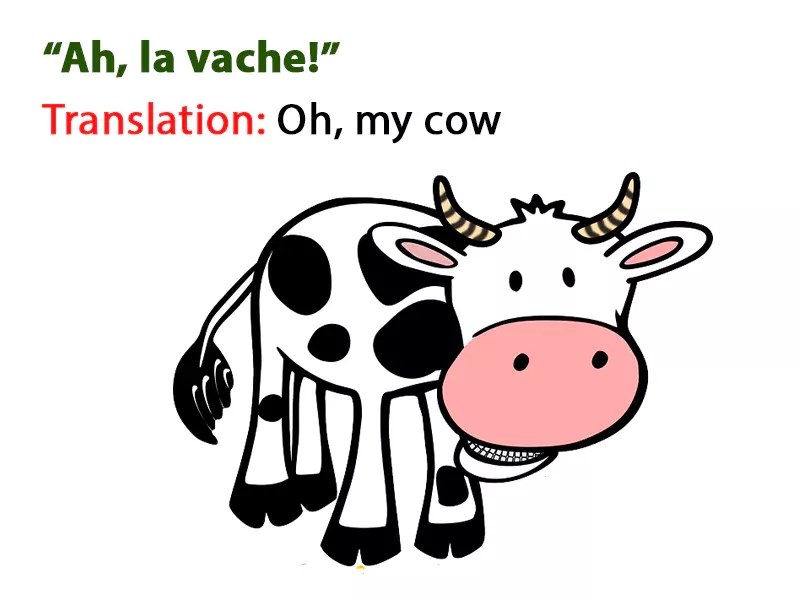
1. “Ah, la vache!”
Translation: Oh, my cow
Don’t worry; no cow is wildly running away. The French phrase “Ah, la vache” expresses surprise and excitement. Its closest English equivalent is “Oh my God.”
2. “Casser les oreilles”
Translation: Break your ears
What will happen when your neighbour is having a late-night electro party? And, imagine they want everyone to know about it by loud volume. That’s the meaning of “break your ears.
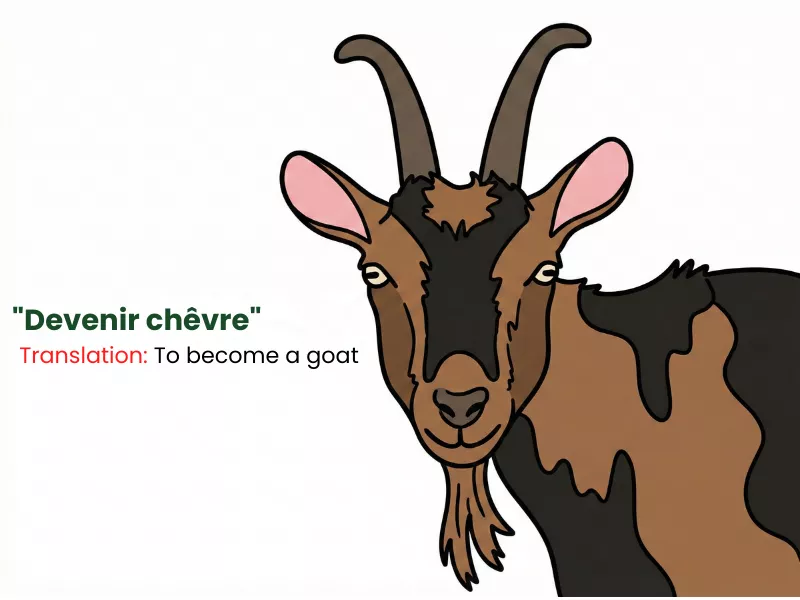
3. “Devenir chêvre”
Translation: To become a goat
The Americans like to utter, “To be driven mad,” however, the French people like to make it clear that anger is not the right state of mind.
That’s why they use one of the famous French sayings, “to become a goat.” In case you are not good at French, then you may surely turn into a goat while trying to understand an angry French person.
4. “Arrête ton char!”
Translation: Stop your chariot
Initially, this French saying was used to slow down something. However, the real meaning of the expression is “to stop bluffing.”
5. “Se prendre/prendre un râteau”
How to Speak Sims Language?
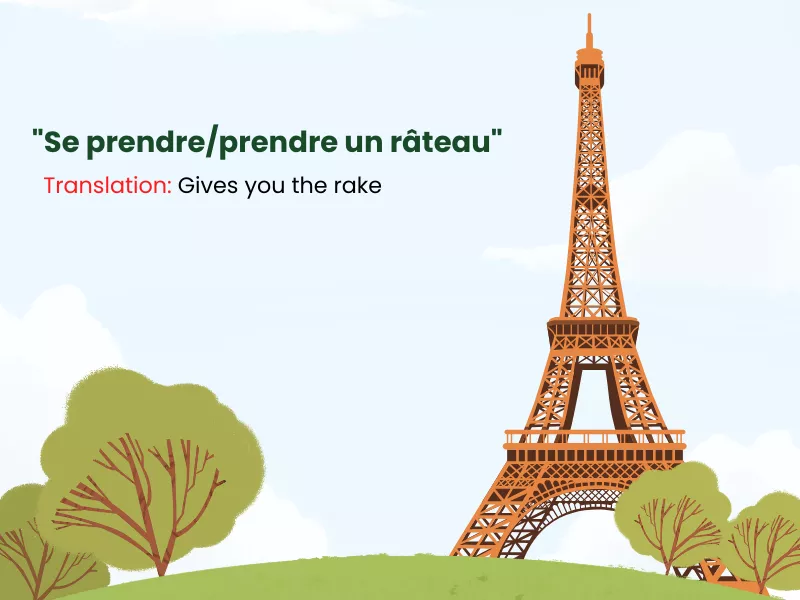
Translation: Gives you the rake
This happens when a man arrives late to go out for dinner with a lovely date. She will leave the place with the note “adieu.” Of course! French women are known for their temper.
In case a French person gives you the rake, that means they refuse to go out with you.
6. “Faire l’andouille”
Translation: To make the sausage
That’s what the French sayings we are talking about. This expression has nothing to do with the food. Then what does it actually mean?
It simply means to do something ridiculous.
7. “Chercher la petite bête”
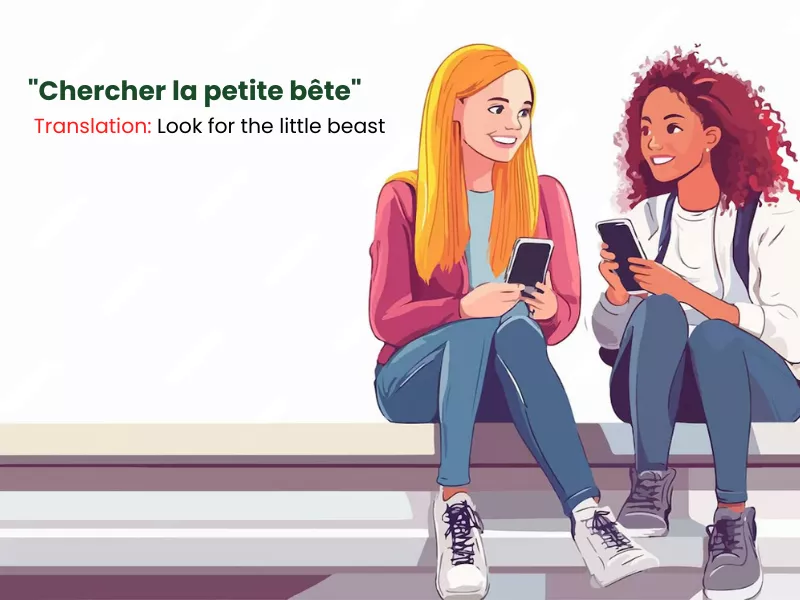
Translation: Look for the little beast
The time when the French person feels really hard-pressed for a reason to complain about something, they will utter, “looking for the little beast.”
The most suitable English equivalent for this phrase is “splitting hairs.”
8. “Être sur son 31”
Translation: Be on their 31
On big occasions, the French people will “Être sur son 31.”
That means they will be wearing beautiful and elegant clothes. You must have seen the Cannes Festival red carpet Events.
This is what typically “be on their 31” entails.
9. “Tomber dans les pommes”
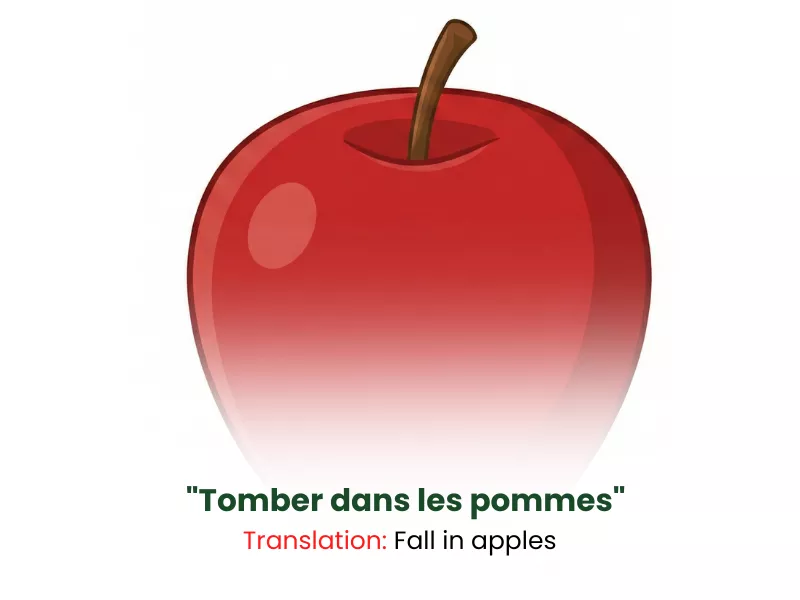
Translation: Fall in apples
The French people fall on the apples when they faint and not on the perfumed bed of roses. So we can understand it easily, “Fall in apples” means the loss of consciousness.
10. “Il y a quelque chose qui cloche”
English Translation: There is something ringing
Imagine there is something wrong. In French, you would say, “Il y a quelque chose qui cloche.” In English, that means “there is something ringing.”
Conclusion
French is one of the most popular languages in the world and is regarded as a language of romance. The French people have their own way of saying things. And like language, French sayings and phrases are also popular.
Many French expressions like “le beau temps” have a different literal meaning in English. However, they mean more than that.
We hope you have enjoyed the 50+ French sayings and phrases given in this blog. Always be connected for more such interesting blogs.
Frequently Asked Questions
What are some cool French words?
French is sometimes referred to as the language of love. For many people, it is one of the most beautiful languages in the world. The language contains some very unique and cool words. Some of them are – Feuilleter, Éphémère, Onirique, Dépaysement, Un je-ne-sais-quoi, Un exutoire, Être à l’Ouest, L’appel du vide, Juilletistes, Aoûtiens, and more.
What are some simple phrases in French?
Some of the top ten phrases used by the native speakers are:
- Je suis désolé: I am sorry
- Excusez-moi: Excuse me
- S’il vous plaît: Please
- Bonsoir: Good evening
- Non, pas du tout: No, not at all
- Merci: Thank you
- Madame/Monsieur/Mademoiselle: Mrs. /Mr. /Miss
- Je voudrais…: I would like…
- Je ne comprends pas: I don’t understand
What are cute French words?
- Some of the cute French words and expressions are given below:
- Un Bisou: Kiss, Remember that in French Québec, this word can be shortened to be with your children.
- Des bijoux: Jewellery
- Ma belle/mon beau: My beautiful or My handsome
- Ma joie: My joy
- Un câlin: Hug or cuddle
- Un canard: Duck
- Sa suce: Pacifier or binky
- Mon chat: Cat

You May Also Be Interested to Know
1. 50+ Amazing Quotes On Language
2. How to Say Thank You in Thai: Common Ways and How to Respond.

Want To See My Profile — Click Here Olivia Jones
- Amazing French Sayings and Proverbs - February 20, 2026
- 50+ Amazing Quotes On Language - July 22, 2024
- Know In Brief The 67 Australian Slang Words Used Commonly - May 30, 2023
