This blog covers every document you need to translate, why NAATI certification matters, which assessment body to approach, and how to avoid common mistakes.
Key Takeaways
- NAATI-certified translation for skills assessment is mandatory. The assessment bodies do not accept translations done by you.
- Your degree or certificate is not enough. You need translated academic transcripts and identity documents.
- Each assessing body has different requirements. They all ask for different sets.
- Incomplete or incorrect translations are the most common reason for delays.
- Your AQF equivalent overseas qualification matters. The assessors match your qualification to it.
What Is Overseas Qualification Recognition in Australia?
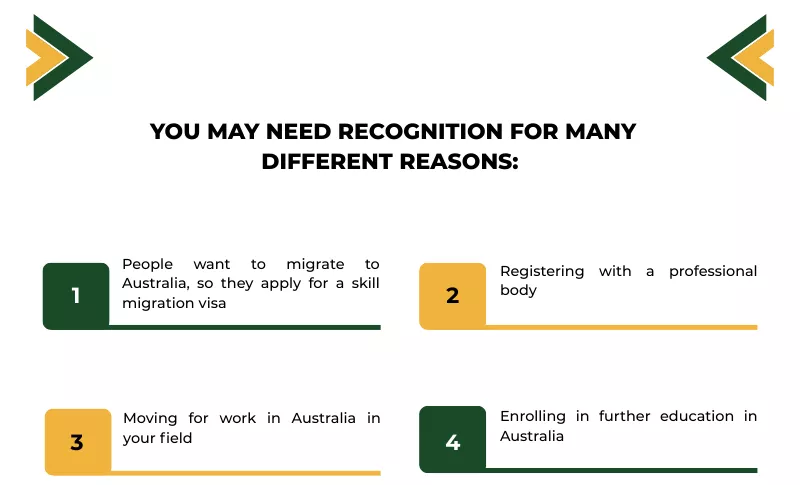
You may need recognition for many different reasons:
Why Do You Need Certified Translation?
These translations for skills assessment documents in Australia are required because:
- It guarantees the translation is accurate and meets the industry requirements.
- It recognises that the translator is professionally accredited.
The government department can rely on it as an official document, and translation services help in providing accurate translations.
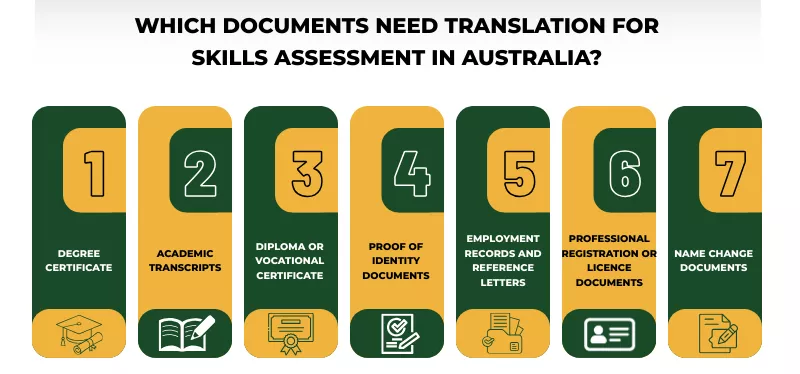
Which Documents Need Translation for Skills Assessment in Australia?
1. Degree Certificate
Your bachelor’s degree certificate is the primary document, and this requirement must be met in any skills assessment application. It confirms that you completed a formal qualification. You must give a translation along with a copy of the original.
For professional degree certificate translation Australia, make sure the degree certificate translation services include the full name of the institution, the title of the degree, the date of conferral, and any qualification assessed.
2. Academic Transcripts
Academic transcripts show every subject you studied, your grades, and the credit points or hours completed. Most qualifications for migration require this in addition to your degree certificate.
When you translate academic transcripts for skills assessment, the academic transcript translation Australia must include all original details accurately, which include grades, grading scales, and subject codes. Errors here can affect your dream to study abroad.
3. Diploma or Vocational Certificate
If your qualification is a diploma, trade certificate, or technical and vocational qualification rather than a university degree, you still need a certified translation. This is especially important for applications through VETASSESS or trade qualifications.
For diploma certificate translation Australia, include the name of the registered training organisation, the qualification title, and the year of completion.
4. Proof of Identity Documents
Assessment bodies may be able to verify your identity. You will need:
- Passport Translation (the biographical data page)
- Birth certificate translation
- National identity card which shows you are a permanent resident (if applicable)
- Marriage certificate (if your name has changed)
These are considered certified document translation for visa Australia and skills assessment outcomes as they are translated by an accredited translator. The translation must match the name on all your academic documents exactly.
5. Employment Records and Reference Letters
Some OQU or other organisations need proof of work experience. If your employment records or reference letters are not in English, you need certified translations of:
- Employment contracts
- Letters from employers stating your role, duration, and responsibilities
- Payslips (in some cases)
6. Professional Registration or Licence Documents
If you are already registered or licensed in your home country, some assessment bodies want to see proof of that registration under the qualifications recognition policy. Translate any:
- Professional membership certificates
- Practising licences
- Registration documents issued by a regulatory authority
7. Name Change Documents
If the name on your academic documents does not match your passport, you have to provide legal proof of the name change. Migration assessing authorities need marriage certificate translations.
Which Assessment Body Do You Apply To?
- VETASSESS: General professional and technical occupations (e.g., accountants, marketing managers, HR professionals)
- Engineers Australia: Engineering professionals
- ANMAC: Nurses and midwives
- AITSL: Teachers
- Trades Recognition Australia: Tradespeople
- Department of Education: General AQF comparisons not linked to migration or licensing
Every assessment organisation has its own list of documents you need to submit. Always check the professional membership or industry requirements before you translate the documents.
Certified vs Notarised: What Is the Difference?
How to Translate Your Qualifications for Australian Migration?
Step 1 — Check with your assessing body and read their document checklist carefully.
Step 2 — Collect the original documents of all the required things.
Step 3 — Hire a translator for each document that is not in English.
Step 4 — Confirm that translated names and dates are consistent across all documents.
Step 5 — Submit originals and translations together as instructed by the assessment body.
Common Mistakes in Required Translations for VETASSESS
- Using non-certified translators: VETASSESS will not accept translations from unlicensed translators, no matter how fluent they are.
- Submitting incomplete transcripts: Missing pages or missing grading scales can cause your application to be put on hold.
- Name inconsistencies: If your name is spelled differently across documents, include a certified translation of your name change document.
- Forgetting reference letters: VETASSESS often needs translated employment references to verify work experience.
- Translating only the degree and not the transcript: Both documents are typically required. Submitting one without the other will slow your assessment down.
How Long Does Overseas Degree Recognition in Australia Take?
- VETASSESS: 7 weeks for a standard professional assessment
- Engineers Australia: 8 to 12 weeks
- ANMAC: varies by pathway, typically 6 to 8 weeks
- Department of Education (general AQF comparison): 6 to 10 weeks
Having all your skills assessment documents ready significantly reduces the risk of delays. Missing or incorrect translations are the most common reasons for long processing times.
Final Word
The translation must be correct and complete if you need to translate your degree certificate. Check what documents your assessing body needs. Then find a qualified translator and prepare your documents carefully. This is the best way to move your application forward and start your career.
Frequently Asked Questions
Do I need translations for overseas qualification assessment?
Yes. All assessment bodies require translations for documents that are not in English. Standard or non-accredited translations are not accepted.
How long does overseas degree recognition take?
Processing times range from 6 weeks to 20 weeks, depending on the assessment body and whether your application is complete. Submitting all required translated documents upfront reduces delays.
How do I translate qualifications for migration?
Find a translator who has certification. Collect all the documents you need. Send the original documents and their certified translations to the assessment body. Before you do anything, check the document checklist on the assessment body’s website.
What are the common mistakes in required translations for VETASSESS?
Many people use translators who are not certified. They also forget to include all pages of their documents. Sometimes the name on one document does not match the name on another. People also forget to get their work reference letters translated.


Want To See My Profile — Click Here Kylie Smith
- Documents for Overseas Qualification Recognition in Australia - March 13, 2026
- How To Apply For An Australian Birth Certificate Replacement? - May 6, 2025
- A Guide to Translating a Restricted or Provisional Driver’s Licence - April 30, 2025