Suppose you’re applying for a visa for Australia and have submitted an uncertified translation to the Department of Home Affairs. Little did you know that it would result in outright rejection. What follows after? Further documentation is needed to fix the situation.
You may have to incur further expenses to get the translation done again by an accredited translator to meet DHA document translation rules. All of this then leads to application delays and missed opportunities. In this article, we will discuss everything in detail, including how to avoid such situations.
Key Takeaways
- Submitting an uncertified translation to the Department of Home Affairs can lead to visa refusal. It also causes application delays.
- All non-English documents must be translated by an expert accredited from National Accreditation Authority for Translators and Interpreters. Otherwise, there will be no acceptance.
- You cannot certify your own translations. Only accredited translators can provide a valid certification.
- Uncertified translations may contain errors or lack accountability. This makes them non-compliant with Australian immigration standards.
- Using a certified translation services provider from the start helps avoid issues. You can easily bypass extra costs, reprocessing, and missed migration opportunities.
Department of Home Affairs Translation Requirements
As per the DHA rules, any supporting documents needed for the visa application, if not in English, must be translated into English. But this English translation of documents must be done by a NAATI translator. These are called certified translations.
NAATI stands for the National Accreditation Authority for Translators and Interpreters. This is an official body that qualifies and authorises professional translators to certify documents translated into English for official acceptance.
In short, Home Affairs asks to provide NAATI certification of any translated document where the official ID, stamp, and name of the translator are reflected.
Why Is Submitting an Uncertified Translation to the Department of Home Affairs Not Allowed?
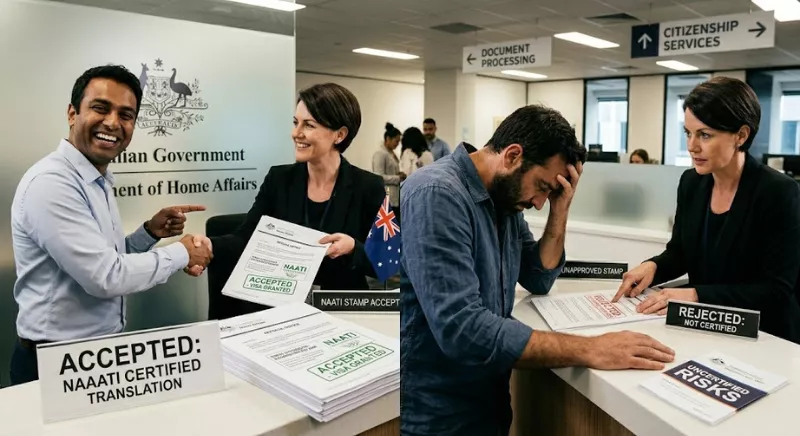
Submitting non certified translation for home affairs application review is not allowed due to integrity concerns. Uncertified translations are considered improper translations as they fail to ensure authenticity and legal compliance. Plus, there is no accuracy guarantee.
On the other hand, certified translation ensures the translated version is the full and accurate rendition of the original document. Non-certified translations may lack required precision as they may include:
- Small errors (e.g., name spelling, incorrect dates)
- Wrong terminology (e.g. specific legal or medical terms missing)
Again, certified translation DHA requirements tend to be strict about authenticity and fraud prevention. Uncertified translations are not backed by translation responsibility from accredited migration translators.
Experts not only translate documents for immigration Australia, but also provide a statement of accuracy certificate that includes genuine translators’ details. This confirms a traceable, accountable, and verifiable record. This also ensures your visa application process goes smoothly without any issues.
Can I Certify Translated Documents Myself?
No! You can not certify your translated document yourself. Your personal statement of accuracy will be considered invalid.
So, who can translate documents for immigration to Australia? Translators who are accredited can certify translated documents.
Accredited translators possess a special ID number and individual QR stamp. These elements authenticate the statement of accuracy on the translation certification.
What Are the Consequences of Uncertified Translation Submission?
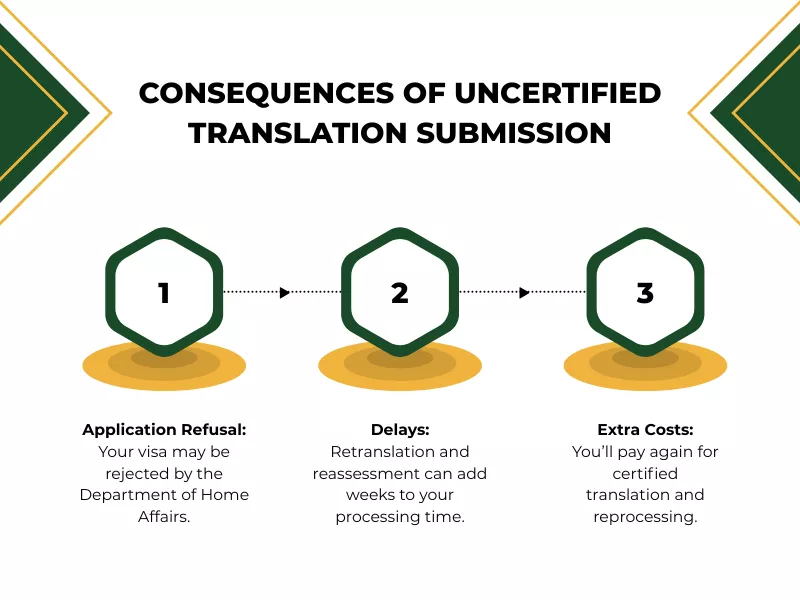
Since uncertified translations do not have legal weight, submission results in non-compliance. As a consequence, you may face the following:
1. Refusal of Australian Migration or Citizenship Application: You may face outright rejection of applications. The reason is the failure to meet the Australian Government standards for translation. You will be requested to reprocess the application by providing a certified translation.
2. Processing Delays: A visa refusal due to translation issues in Australia typically causes a delay of 6 to 12 additional weeks beyond the original expected processing time. Here’s a breakdown:
| Initial Identification | Time taken for the agency to check and notify you of the error | 2–3 weeks |
| Retranslation Process | Time to find a certified translator and get documents re-certified | 1–2 weeks |
| Resubmission/Re-processing | New home affairs document verification process of the application from scratch. | 2–4 weeks |
What Document Types Need Certified Translation to Meet Australian Immigration Standards?
Types of Visa Document Translation that need certification while migrating to Australia generally include:
a. Identity Documents
If issued in another language, a certified English translation of identity documents is needed. This includes:
- Birth certificate translation
- Translation of National ID cards
- Translation of Name Change Certificates
b. Civil Status Documents
If applying for partner visas, family visas, and dependent applications, you will require
- Marriage certificate translation
- Divorce certificate translation
- Death certificate translation
- Translation of Custody or guardianship documents
- Single Status Certificate translation
c. Travel Documents
Home Affairs often asks for evidence of travel history and lawful stay in another country. You may need the following
- Passport Translation
- Diver’s License Translation
d. Employment Documents
If you are applying for a work visa or immigrating through skilled migration pathways, you will need translations for the following documents:
- Professional licenses
- Employment contracts
- Employee reference letters
e. Education Documents
For a student’s visa application, you need to submit
- Degree Certificate Translation
- Diploma Certificate Translation
- Academic Transcript Translation
f. Financial Documents
To prove that you are financially capable of sustaining your stay in Australia, you need to provide:
- Bank Statement translation
- Tax record translation
- Translation of Pay slips for proof of income
g. Legal & Government Documents
A background check is mandatory during individual visa processing. In this case, you have to provide
- Police Clearance Certificate Translation
- Police Report Translation (if any)
If you are involved in overseas legal matters, you may need to provide:
- Court judgments
- Legal records issued overseas
- Power of attorney translation
In some cases, DHA may also ask for the translation of official government-issued documents like military service records or exemption certificates.
How to Avoid Getting Your Document Translations Rejected?

To reduce the chance of getting your application rejected, it is best to send your documents for translation to a professional language provider who specialises in certified translation services in the first place.
Once such a provider is AustralianTranslationServices. They can translate a wide variety of overseas documents for Australian visa. Whether applying for a Visa or citizenship, they offer straightforward language solutions to meet the needs.
Here you can connect with translators who are certified by NAATI. You will get accurately translated documents that ensures 100% compliance for official acceptance.
You will get a fixed quote, starting at AUD 60 per page. They offer 48 hours of standard turnaround. However, if you need fast service, the express option is also available.
Conclusion
Frequently Asked Questions
Uncertified translation vs NAATI for Home Affairs—which to choose?
For general uses where the goal is to convert a message in a target language to convey the meaning, uncertified translation is ideal. Examples include marketing copies, internal HR documents, etc.
When it comes to official use cases like a Visa application, overseas legal settlement, or a citizenship application, the law requires translations to be done by a certified translator.
Can I use an uncertified translation for a partner visa with Home Affairs?
No! As per the translation requirements for Home Affairs Australia, submitting uncertified translations is not allowed for a partner visa.
How do I find and verify a NAATI-accredited translator in my country?
The easiest way to find an accredited translator is to do a simple Google search. You will find plenty of online translation service providers offering NAATI solutions.
Are there any ways to reduce translation costs or get financial assistance for the required documents?
While the certified translation fee is fixed, you may get a bulk order discount. This is possible if you have a huge translation requirement. Talk to your language provider to get an overhead discount. Next, try to get the translation done early to avoid a last-minute rush. This helps you save the extra fee needed for express delivery.
Are there any exceptions where uncertified translations might be accepted by Home Affairs?
No, unfortunately, there is no room for uncertified documents to be accepted at DHA. Your translated documents must be certified.
How should I submit certified translations—originals, scans, or both?
You need to upload a high-quality scan of the certified translated document. You also have to upload the original non-English document in the same way. This needs to be done during the online application of visa at department of Home Affairs website.
What should I do if I realise I submitted an uncertified translation after applying?
Act fast if you lodged an Uncertified Translation to the Department of Home Affairs. Do not quit your case. Tell them via your online account or Form 1023 now. Just get a certified copy and upload it. This helps you avoid long waits or the loss of your visa file.


Want To See My Profile — Click Here Jack Nguyen
- What Happens If You Submit an Uncertified Translation to the Department of Home Affairs? - March 9, 2026
- NAATI Translation Cost 2026: A Complete Pricing Guide for Australia - February 26, 2026
- Filipino Language: History And Unrevealed Interesting Facts - January 13, 2026