How to Become a NAATI Translator or Interpreter in 2026?
The NAATI certification process is built on three pillars: completing formal training and prerequisites, passing a certification test, and engaging in continuous professional development for recertification every three years. In this article, we will discuss how to become a NAATI translator, explaining everything in detail. If you want to become a language expert in translation or interpretation, keep reading to know everything.
What Is NAATI Certification?
NAATI Certification is Australia’s national standard for professional translators and interpreters, authorised and granted by the National Accreditation Authority for Translators and Interpreters (NAATI).
The NAATI Certification System was designed based on extensive research and consultations aimed at identifying the essential knowledge, skills, and attributes required for successful practice. As per the latest data, by the end of 2024–25, over 8,800 practitioners held more than 13,000 NAATI certifications across 180 languages.
Holding a NAATI endorsed certification demonstrates that an individual meets the established community expectations for professional competence. This ensures that certified professionals are adequately equipped to provide high-quality language services.
Websites like AustralianTranslationServices collaborate with NAATI-accredited professionals to deliver NAATI Translation Australia services. Are you looking for a NAATI translator for your documents? Visit our dedicated service page.
How to Become a NAATI Certified Translator?

The journey to obtaining NAATI certification is structured around three fundamental pillars, which may vary depending on the specific credential being sought.
Completing Formal Training and Meeting the Prequisites
You must complete a formal training in interpreting or translation before you can apply for certification and officially start providing certified translation and interpretation services. Also, you must satisfy other specific prerequisites that include demonstrated English proficiency, as well as intercultural and ethical competency. These requirements differ based on the level and type of credential.
There are two main pathways to complete your educational training:
- NAATI Endorsed Courses: This pathway involves enrolling in comprehensive qualifications such as a Diploma, Advanced Diploma, Bachelor’s degree, or Master’s degree from a NAATI-endorsed provider. A full list of NAATI Endorsed Qualification courses and providers can be found on the NAATI website. These programs offer an in-depth exploration of the skills and knowledge you need for a solid career in the field. A potential challenge with this option is the difficulty in finding courses that cover specific or less common language streams.
- NAATI Skill Set Courses: These shorter interpreting and translating courses are suitable for candidates whose language is not offered in a NAATI-endorsed course. You get equipped with the minimum essential skills and knowledge required to prepare for interpreting or translating work.
No matter which pathway you choose, once you complete these courses, you become eligible to apply for the relevant NAATI certification exam.
Passing the Assessment by NAATI: What Does the Test Involve?
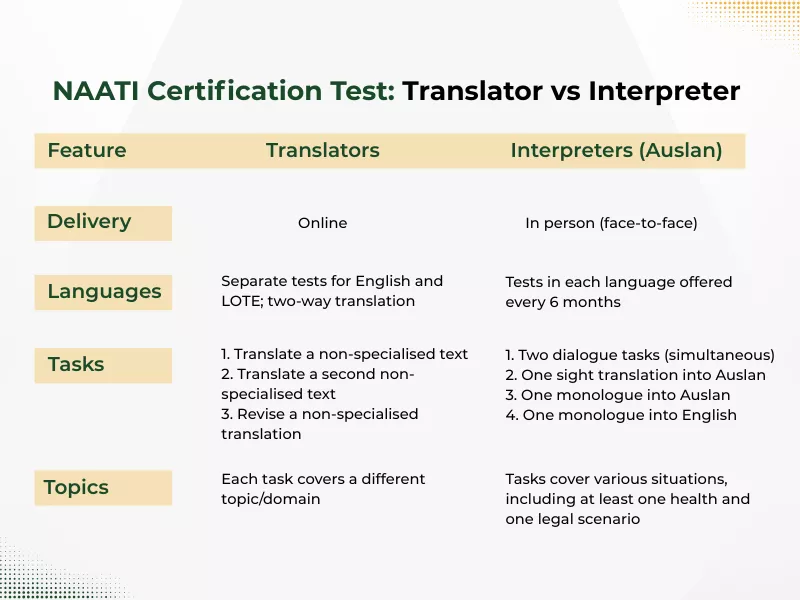
Becoming a NAATI certified interpreter or translator requires a candidate to pass a formal certification test with NAATI. During the NAATI Certification Process, this is an objective assessment of the core competencies required to practice as a professional translator in Australia.
For Translators
It’s simple; in the test, you have to accurately transfer a written message from a source language into a written message in a target language.
Test Structure and Content:
| Delivery | The test is delivered online. |
| Languages | Separate tests are conducted for English and LOTE (Language Other Than English). This will be two-way (translation from a LOTE into English and from English into a LOTE). |
| Tasks | 1. Translation of a non-specialised text.
2. Translation of a second, different non-specialised text (e.g. Arabic). 3. Revision of a non-specialised translation. |
| Topics | Each task is based on a different topic from a different domain. |
| Restrictions | Candidates are strictly prohibited from using Microsoft Word or any other grammar and/or spelling assistance tools during the test. |
Candidates are advised to thoroughly review all official information on the NAATI website, including materials on test marking, identity verification, and language policies, before sitting the exam.
Note: For certain credentials, such as Recognised Practising Credentials (medical, legal, etc), you may instead be required to demonstrate your relevant practice in that area.
For NAATI Interpreters (Auslan)
| Delivery | The interpreter test is conducted in person (face-to-face). |
| Structure | The assessment consists of five tasks covering various situations from different domains, including at least one health-related task and one legal-related task. |
| Dialogue Tasks | Two dialogue interpreting tasks (simultaneous interpreting). |
| Sight Translation | One sight translation into Auslan, related to and delivered immediately after the second dialogue task. |
| Monologue Tasks |
|
| Frequency | Tests for each language are offered every 6 months. |
Note: Candidates should read the detailed instructions under the Prepare for your test tab and refer to the glossary of certification terms if needed.
Recertification Every Three Years
All NAATI credentials are valid for a period of three years. To maintain holding NAATI certification, professionals must apply for recertification by providing evidence of continuous professional development.
This involves demonstrating the active maintenance of their language skills and consistent work practice. This recurring process ensures that only active professionals who continue to meet NAATI’s high standards retain their credentials.
Many organisations like NEXPD provide a range of specialised courses and workshops to support candidates through both certification and recertification. These learning opportunities help interpreters and translators build the targeted knowledge and skills required to succeed in certification tests and uphold professional standards.
Conclusion
Becoming a NAATI translator or interpreter in 2026 is a structured yet rewarding pathway that combines formal training, rigorous assessment, and ongoing professional development. By meeting NAATI’s standards, practitioners gain industry-recognised credentials that open doors to diverse and meaningful language-service careers. Whether you pursue translation, interpreting, or specialised fields, NAATI certification equips you with the skills, credibility, and professional scope to thrive in Australia’s expanding language services sector.
Frequently Asked Questions
How much does it cost to become a NAATI translator?
Expect to pay 605 AUD per language direction for the test, plus 198–220 AUD if NAATI must assess your prerequisites. Optional extras include marked practice tests (165 AUD) and test reviews (275 AUD). Physical ID cards or stamps cost 88–220 AUD, though digital versions are free. Training costs are separate and depend on your education provider.
What qualifications do I need to become a translator?
You’ll need formal translation training at AQF Level 6 (Advanced Diploma) or higher, ideally through a NAATI-endorsed course. NAATI also checks language proficiency, ethics, and intercultural skills. For migration assessments, you typically need a diploma-level qualification plus evidence of paid translation work.
How much do translators get paid in Australia?
Translators earn an average of around 108,000 AUD per year, depending on language pair, experience, and work type. Many charge per word or per document, standard certified translations (e.g., birth certificates) often start at around 69 AUD.
How do I become a certified translator?
Complete formal training, meet NAATI’s prerequisite requirements, apply online, and then sit the 605-AUD Certified Translator test. If you pass, NAATI grants certification and provides free digital ID and stamp access.
What is The Professional Scope for NAATI Holders?
Professionals who hold NAATI credentials work across a wide range of language services, supported by a comprehensive qualification that dives deep into real-world communication needs. For example, the vast scope includes:
- With a certified interpreter credential, practitioners handle on-site, video, phone, legal, medical, business, community, and conference interpreting in various modes.
- Becoming a certified NAATI translator lets you work on legal, medical, technical, business, personal, and digital content.
- You can offer Localisation services that include adapting websites, apps, software, and games for culturally and linguistically diverse audiences.
- Become an expert provider of Auslan Services, offering face-to-face and remote interpreting, notetaking, theatre work, and specialist Auslan consulting.
- Become an Audio-Visual practitioner offering subtitling, voice-overs, dubbing, transcription, multilingual video production, and live streaming.
Together, these services highlight the broad and impactful professional scope available to NAATI-certified practitioners.

Want To See My Profile — Click Here Jack Nguyen
- NAATI Translation Cost 2026: A Complete Pricing Guide for Australia - February 26, 2026
- Filipino Language: History And Unrevealed Interesting Facts - January 13, 2026
- How to Become a NAATI Translator or Interpreter in 2026? - December 11, 2025