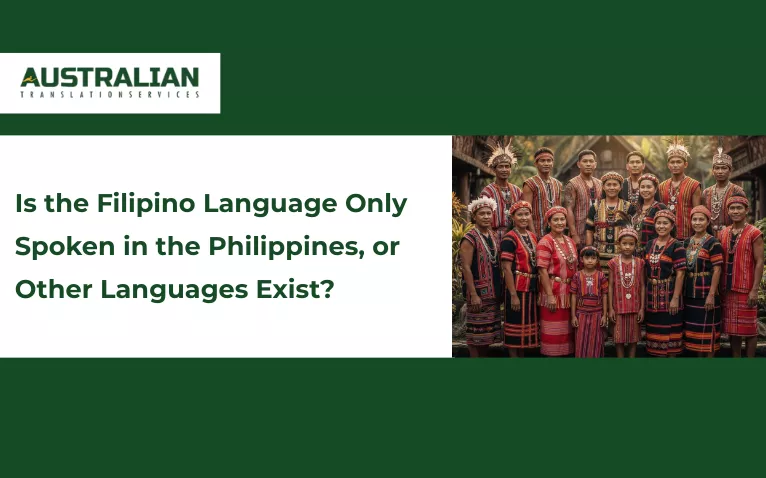
Filipino language is the national language of the Philippines, and currently, it is one of the two official languages of the country, alongside English as a Second Language. Filipino is a standardised version of the Tagalog language, belonging to the Austronesian language family and spoken by more than 83 million individuals as the first or second language. And, this is not the only language used here; in addition to that, there are also 183 unofficial indigenous or regional languages (most of which are now endangered) spoken on the 7,641 islands that comprise the country. We are going to talk about the interesting history and the fun facts about Filipino language and other Philippine languages in this article. Keep reading!
Key Takeaways
- The Filipino language is the national language of the Philippines and is basically a standard form of Tagalog, which is of the Austronesian family.
- Although it is one of two official languages, Filipino exists in an archipelago of 183 native and regional languages spoken in more than 7,000 islands.
- Spanish and American colonisation influenced the history of the Filipino, which resulted in a conscious national movement in 1937 to choose Tagalog as its main foundation.
- The Filipino is also linguistically described as an agglutinative and pitch-accented tongue that employs a modern 28-letter alphabet to accommodate a wide variety of loanwords.
- Despite its widespread usage, the dominance of the Filipino language in public and educational spaces has contributed to the endangerment of several native regional tongues that now face extinction.
The Historical Context of the National and Official Languages of the Philippines
The evolution of the Filipino language is a multifaceted historical story influenced by the linguistic diversity of pre-colonial times, a 300-year history of Spanish rule, an era of American colonisation, and an intentional language nationalism movement of the 20th century.
Pre-Colonial and Spanish Era
The Philippines is a multilingual archipelago comprising 175 to 183 living languages that derive their origins from a common Malayo-Polynesian language. There was no common language before the onset of Spanish colonisation in 1565. But Visayan, Ilocano, and Tagalog were lingua franca.
The Spanish placed their capital in Manila, a Tagalog-speaking region, which increased the popularity of the language. The 300-year Spanish colonial history resulted in the introduction of the Spanish language as the official language of Philippines government and served to unify the islands.
This was a very significant era in the history of Tagalog, and it received around 4,000 loanwords that were borrowed from Spanish. The first dictionary of Tagalog, Vocabulario de la lengua tagala, was published in 1613 by Franciscan Pedro de San Buenaventura. To know more about “What is Tagalog?“, read our other blog.
Also, if you need any kind of language help (interpreting or translation services Australia), in the Filipino language as the source or target language, contact the linguist specialists at AustralianTranslationServices.
The National Language Movement
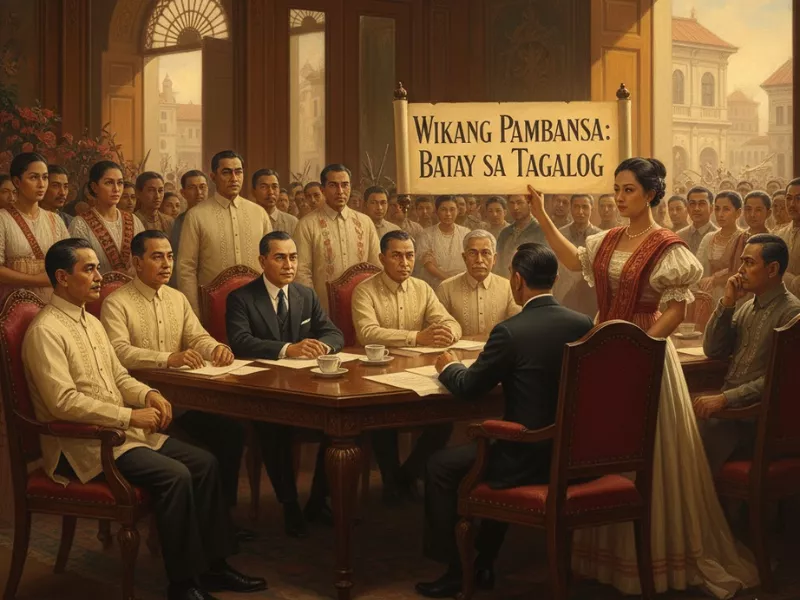
Establishment of the Institute: On November 13, 1936, Commonwealth Act No. 184 created the Institute of National Language (later Surián ng Wikang Pambansâ or SWP) to study the native languages and select one as the basis for the national language.
Selection of Tagalog: In 1937, the National Language Institute recommended Tagalog. The Tagalog was declared to be the foundation of the national language by the order of President Manuel L. Quezon dated December 30, 1937, through Executive Order No. 134.
Justification for Selection: The choice of Tagalog was based on several factors:
- It was the most common and familiar language in the regions.
- It was not divided into smaller “daughter languages” like Visayan or Bikol.
- It had the richest literary tradition of all Philippine languages.
- It was the language of Manila, the ancient political and economic hub.
- The Katipunan revolutionary movement used it operationally.
Love exploring languages? Consider reading the interesting facts about the Esperanto Language too!
Evolution from Tagalog to Filipino
The name and official status of the national language evolved through several key constitutional and administrative changes.
- Pilipino (1959): Tagalog became known as Pilipino in 1959 to dissociate it from the Tagalog ethnic group and foster a more national identity. This variation was not unanimously welcomed, especially among speakers of Cebuano.
- Filipino (1973 & 1987): A purist movement in the 1960s that inspired new words to use instead of loanwords elicited criticism and counter-movements. The 1973 Constitution first demanded that a common national language be developed to be referred to as the Filipino language and declared Filipino and English as the official languages. This was eventually cemented by the 1987 Constitution Language Policy, which declared Filipino the national language, together with English as the Philippines official language.
Currently, English is predominantly spoken in government, business, and education, and an admixture of Tagalog and English (so-called Taglish) becomes an ordinary form of communication.
If you want to explore more about Tagalog vs Filipino, read our other blog.
Key Facts about the Filipino Language: Linguistic Characteristics

The Filipino language is a part of the Austronesian family or the Central Philippine branch. The language can be referred to as Tagalog-based. It is closely related to Cebuano, Hiligaynon, and other Bisayan languages. It is actually among the Hardest Languages To Learn. Let’s understand why:
- Grammar: It is an agglutinative language, in which words are composed of smaller units with meaning. Its sentence structure can be flexible, and often the order of verb-subject-object (VSO) is used, although subject-verb-object (SVO) is also possible.
- Phonology: The Filipino language has 21 phonemes (16 consonants, 5 vowels). It is not a tonal language but is regarded as a language with a pitch-accent and syllable-timed language.
- Alphabet: The modern Filipino alphabet contains 28 letters, an expansion from the 20-letter Abakada alphabet introduced by Lope K. Santos. This was changed to better fit the loan words and sounds of other Philippine and foreign languages.
Filipino Language Trivia
According to 2010/2020 data, there are 29 million speakers of the Filipino language as a first language (L1) (they are known as Filipinos). Once again, 54 million people speak this language as a second language (L2). According to other sources, the total number of speakers is over 100 million.
The national language is celebrated in the month of August annually in what is popularly called Buwan ng Wika (Language Month). This cultural holiday of the Filipinos was set up to coincide with the month that President Manuel L. Quezon was born, who is considered the Ama ng Wikang Pambansa (Father of the National Language).
It started as a week-long festival (Linggo ng Wika) but changed to its present month-long version under the signing of President Fidel V. Ramos into law in 1997.
Other Languages Spoken in The Philippines
The Philippines is a highly linguistic country. The probability of two random citizens speaking different languages is 80 percent. This is a huge variety that is a central aspect of Filipino culture. Tagalog is the language of Manila, and the Filipino language is the official language,e but there are numerous other languages that flourish in the islands and other provinces that surround it.
Hundreds of years ago, different communities came to the Philippines and introduced distinct patterns of speech. Even historians associate certain early linguistic origins with early Malay settlers.
Major Regional Languages

Other than the Filipino and Tagalog, there are a number of native languages with millions of active speakers.
- Cebuano (Bisaya): About 18.5 million people speak this. It is the official language spoken in central Visayas and some regions of Mindanao. The majority of the population generally calls it Bisaya.
- Ilokano: This is the third most popular native language. Ilokano is spoken by about 10 million individuals in the north-western part of Luzon and by other migrants.
- Hiligaynon (Ilonggo): Roughly 9.1 million people speak this, mostly in the Western Visayas region.
While a person might call their home tongue a dialect, these regional voices are technically distinct languages. Every local language offers a distinct identity to the area.
In schools, the government often uses the mother tongue as a medium of instruction for younger students. However, keeping these languages alive often depends on voluntary language use at home.
The Threat of Extinction
There is a growing risk to the unique language in the Philippines landscape. Ethnologue currently lists 28 endangered Philippine languages. This number has doubled since 2016.
- Extinction Risk: Eleven of these tongues face total extinction.
- Usage Decline: Major regional languages like Kapampangan and Pangasinan are also declining.
- Public Shifts: More people now switch to Filipino in public spaces, causing local tongues to fade.
Preserving these diverse voices is essential to keeping the country’s history and old Filipino identity alive. If the current trend continues, many of these unique linguistic features may disappear forever.
Conclusion
Although Filipino is the national language, it is a small part of the multi-ethnic reality of this country. The cultural heritage of the Philippines is enormous, and it has more than 180 native languages, such as Bisaya and Ilokano. Nevertheless, these local voices are unique and, therefore, it is critical to preserve them in the face of extinction. Embracing this diversity keeps history alive. If you need professional translation or interpreting, expert linguists can bridge the gap across these many vibrant Philippine languages.
Frequently Asked Questions
Are Tagalog and Filipino the same?
No, technically, but they are too closely related. Central Luzon has a regional language called Tagalog. Tagalog is the nationalised and standardised variety of the Filipino language. Filipino incorporates English, Spanish and other Philippine languages vocabulary to become more representative of the larger Filipino cultural identity.
What language is mostly spoken in the Philippines?
The most spoken language in the country is Tagalog (Filipino language). The second language is English and is used as an official business, law, and educational language. Other significant regional languages are Cebuano (Bisaya), Ilocano and Hiligaynon.
How do you say hello in Filipino?
The simplest expression of greetings in the Filipino Language is Kumusta (equivalent to the Spanish phrase ¿Cómo está?). You can respect elders or superiors by inserting the particle po, which means Kumusta po. In informal meetings, most locals would simply say the English word Hello or Hi.
Are the Filipino and Spanish languages the same?
No, they are all different language families. The Filipino language is an Austronesian language, and Spanish is Indo- European. But due to the 333 years of Spanish colonialism, the Filipino language has acquired approximately 4,000 Spanish loanwords, such as names of days of the week and domestic items.
What are some essential Filipino words?
To navigate daily life in the Philippines, keep these Filipino words in mind:
- Salamat – Thank you
- Oo / Hindi – Yes / No
- Paki – Please
- Paalam – Goodbye
- Po / Opo – Respectful expressions at the end of a sentence when addressing older people.
You May Also Be Interested to Know
1. Simlish: All You Should Know About The Simlish Language
2. The Mandarin Language: Its History, Influence and Description
3. Tigrinya Language Facts You Must Know
4. The Importance of Turkish Language And Why You Should Learn It
5. What is Evaluative Language Meaning and Examples of Evaluative Language?

Want To See My Profile — Click Here Jack Nguyen
- NAATI Translation Cost 2026: A Complete Pricing Guide for Australia - February 26, 2026
- Filipino Language: History And Unrevealed Interesting Facts - January 13, 2026
- How to Become a NAATI Translator or Interpreter in 2026? - December 11, 2025