“Our nation is stronger because of our diversity and the way we live and work harmoniously together.” – Governor-General Sir Peter Cosgrove
What Cultural Diversity in Australia Means?
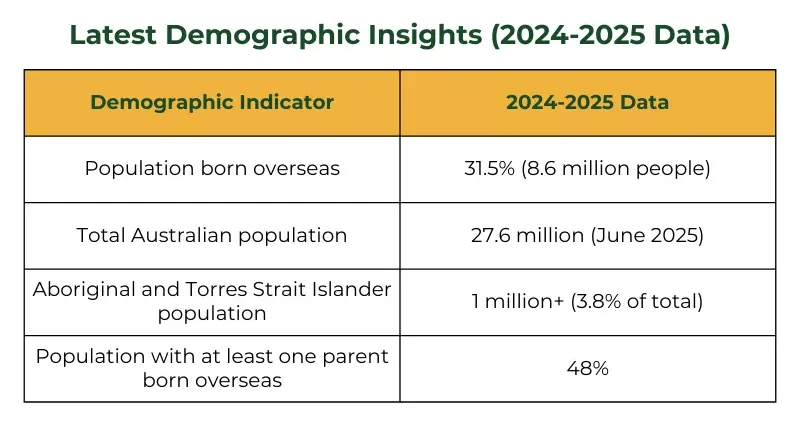
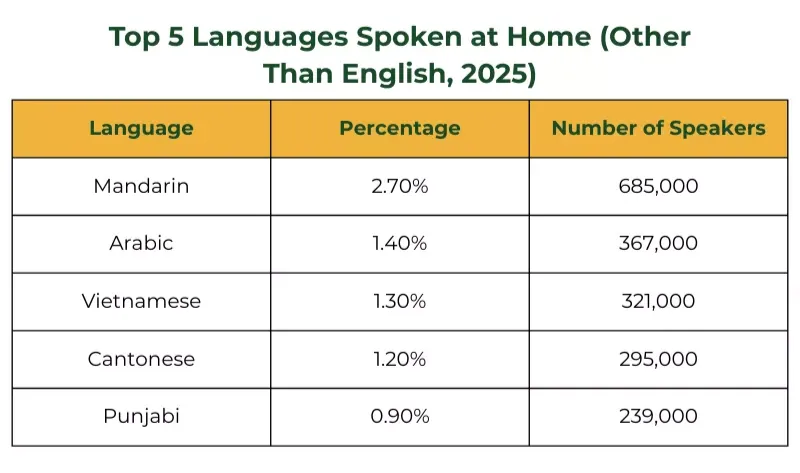
Cultural diversity in Australia is all about inclusivity and respect. Home to the world’s oldest continuing living culture and non-indigenous Australians identifying over 300 different ancestries, Australia basks in its historical glory. More than 1 in 5 Australians speak a language other than English at home, often requiring a NAATI Certified Translator for official document processing. In fact, more than 30% of the Australian population was born overseas. The Aboriginal and Torres Strait Islander population increased to 1 million in 2025.
Considering the facts mentioned above, you must be intrigued to learn more. Read this blog as it walks you through the country’s cultural groups and ethnic diversity. So, let’s get on a journey to explore Australia’s cultural backgrounds and rich heritage.
Latest Demographic Insights (2024-2025 Data)
Top 5 Languages Spoken at Home (Other Than English, 2025)
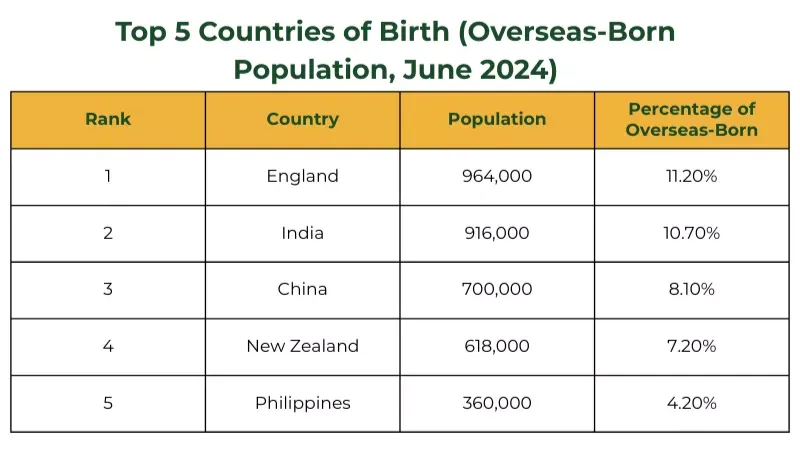
Top 5 Countries of Birth (Overseas-Born Population, June 2024):
Trend Chart: Growth in Overseas-Born Population
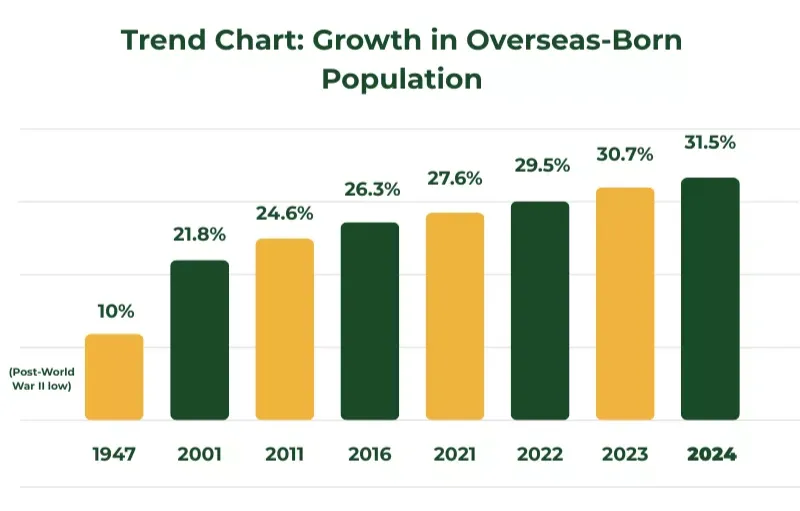
This represents the highest proportion since 1893, reflecting Australia’s commitment to multiculturalism and immigration. The proportion exceeded 30% for the first time in over 130 years in 2023, marking a continuation of its upward trend.
Historical Evolution of Cultural Diversity in Australia
Indigenous Cultures: The Foundation (60,000+ Years)
Australia’s Indigenous people arrived approximately 60,000 years ago, establishing the world’s oldest continuous living culture. There were more than 250 First Nations languages and 800 dialects spoken across the continent. Aboriginal and Torres Strait Islander peoples developed sophisticated systems of land management, cultural practices, and spiritual beliefs that continue to influence Australia today.
British Colonisation (1788 Onwards)
British colonisation in 1788 introduced Western Christianity, constitutional monarchy, and the English language. This period marked profound changes for Indigenous populations, resulting in dispossession, disease, and cultural disruption. The colonial era established Anglo-Celtic cultural dominance that would persist for over a century.
Early Migration Waves (Pre-1945)
The rich history of migration and trade in Australia dates back to pre-British colonisation. The Gold Rush of the 1850s attracted diverse migrants, including Chinese, German, and Italian prospectors. However, the Immigration Restriction Act of 1901 (White Australia Policy) limited non-European migration for much of the 20th century.
Postwar Migration and Transformation (1945-1973)
A new wave of migration began after World War II, driven by labour shortages and a “populate or perish” mentality. Australia welcomed over 2 million European migrants from Italy, Greece, Germany, the Netherlands, and Eastern Europe between 1945 and 1970. These communities transformed Australian society, introducing new languages, cuisines, and cultural practices.
The Multicultural Era (1973-Present)
The dismantling of the White Australia Policy in 1973 marked a turning point. Australia embraced multiculturalism as official policy, opening doors to Asian refugees fleeing persecution in Southeast Asia, as well as migrants from the Middle East, Africa, and South Asia. Today, Australia officially celebrates cultural diversity while promoting social cohesion, with policies supporting both cultural maintenance and integration. Australia emerged as a flourished country where people look up for jobs, immigration, etc. If you want to translate your important documents for these purposes and more, contact Australian Translation Services.
Diverse Cultures In Australia – Four Main Features
Australia is known for its diverse cultural experiences and the many languages spoken. It encompasses various linguistic, cultural, social, and religious backgrounds. The cultural and ethnic diversity in Australia can be further categorised into four features, namely:
Political Diversity:
A variety of political ideologies, opinions, and systems coexist in Australia. Diversity is evident in multiparty systems, including the National Party, the Greens, the Labour Party, and the Liberal Party. As a result, a wide range of perspectives is reflected in policymaking, leading to more robust and inclusive decision-making mindsets.
Social Diversity:
Social diversity in Australia encompasses various social backgrounds, beliefs, values, and lifestyles among individuals. It recognises different family structures, gender identities, sexual orientations, and classes. As a result, social diversity challenges discrimination and fosters a more harmonious society. It leads to a peaceful coexistence and promotes cultural sensitivity.
Economic Diversity:
Australia has a significant range of occupations, industries, and economic statuses. It has a mixed economy with manufacturing, agriculture, and mining industries. Thanks to different cultural practices and diversity, it can mitigate economic downturns. Reason? With various industries cropping up, the risk can be spread across various sectors.
Cultural Diversity:
From one or both parents born individuals to migrant communities – Australia is home to diverse cultures. This is what sets it apart from other nations around the globe. The 2021 census says 29% of Australia’s population was born overseas. 20% had at least one parent who was born overseas. The Western culture in Australia was influenced by Britain, the continent’s geography, and the endless contributions of Aboriginals, Torres Islanders, and Oceania people. That also answers what is glocalisation from a neutral point of view.
Current Demographic Profile
Ancestry and Heritage
According to the 2021 Census, the top five ancestries in Australia are:
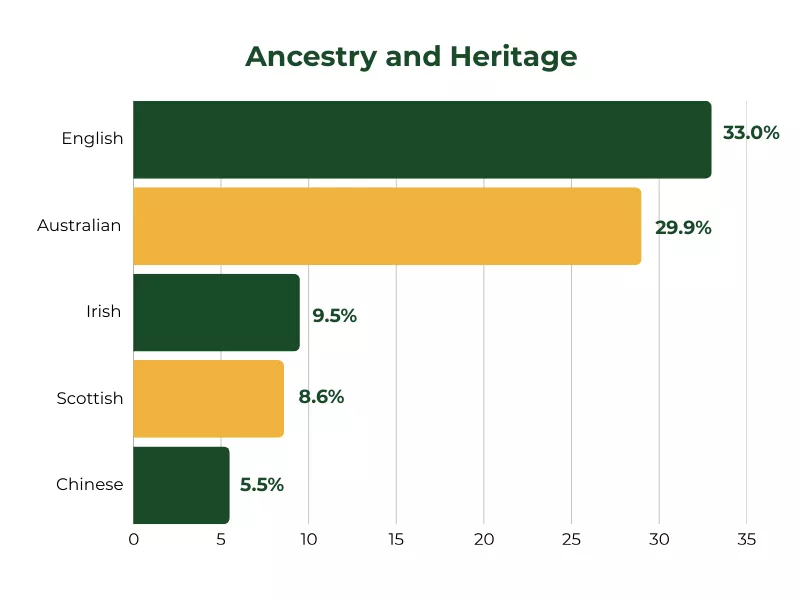
- English (33.0%)
- Australian (29.9%)
- Irish (9.5%)
- Scottish (8.6%)
- Chinese (5.5%)
However, with India emerging as the second-largest source of overseas-born residents in 2024, Australia’s ancestral composition continues to diversify rapidly.
Religious Diversity
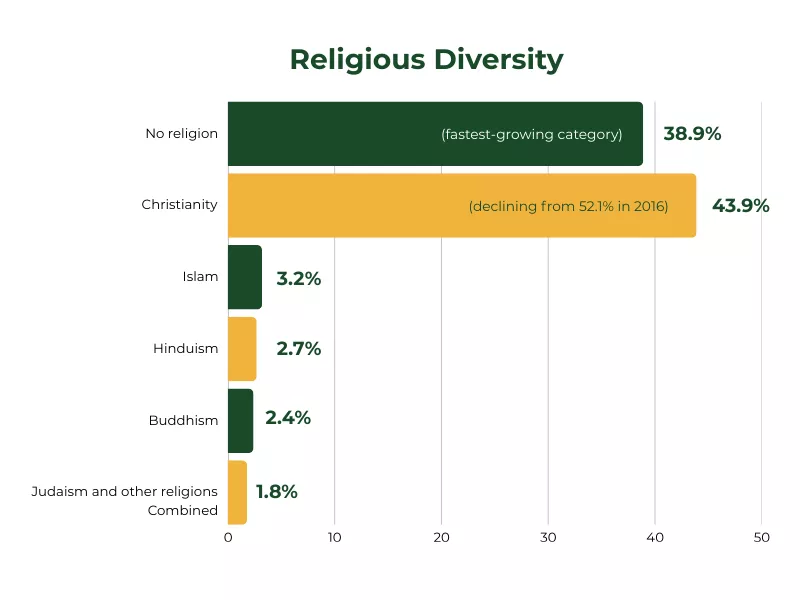
Australia’s religious landscape reflects its multicultural composition (2021 data):
- No religion: 38.9% (fastest-growing category)
- Christianity: 43.9% (declining from 52.1% in 2016)
- Islam: 3.2%
- Hinduism: 2.7%
- Buddhism: 2.4%
- Judaism and other religions: Combined 1.8%
Geographic Distribution
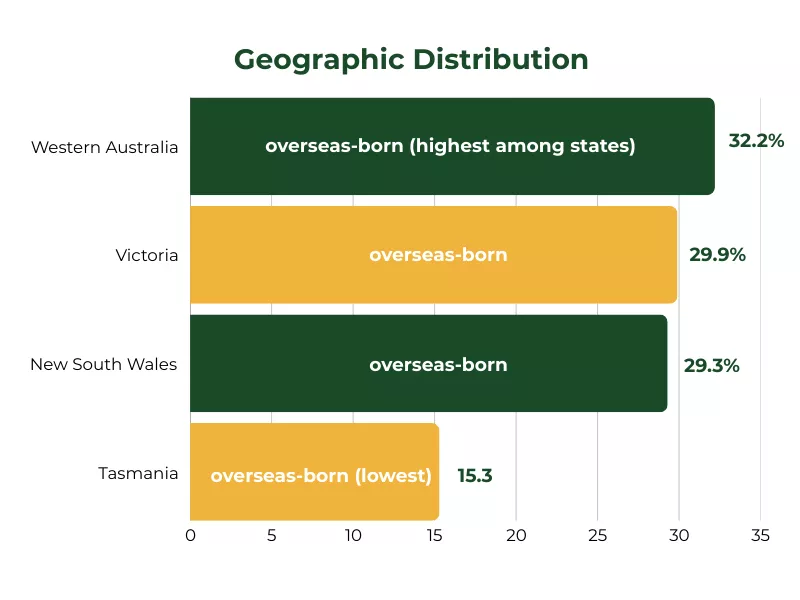
Cultural diversity varies significantly across Australia (2021 data):
- Western Australia: 32.2% overseas-born (highest among states)
- Victoria: 29.9% overseas-born
- New South Wales: 29.3% overseas-born
- Tasmania: 15.3% overseas-born (lowest)
Major cities demonstrate the highest concentration of cultural diversity, with Sydney having 42.9% of residents born overseas, making it one of the world’s most multicultural cities.
Social and Economic Impacts
Economic Contributions
Multiculturalism generates substantial economic benefits:
- Skilled migrants fill critical workforce gaps in healthcare (28% of doctors are overseas-born), technology, engineering, and construction
- Migrants are 1.6 times more likely to start businesses than Australian-born residents
- Cultural diversity strengthens trade connections, particularly with Asian economies
- International education contributes approximately $40.3 billion annually to the economy
Benefits of Multiculturalism in Australia
The cultural impact of diversity in Australia benefits non-English-speaking and English-speaking communities.
Here’s a lucid overview of the key benefits of cultural diversity in Australia.
→ Helps put racial discrimination to an end.
→ Develops and sustains a positive view of the country.
→ Fosters a healthier work culture and promotes creativity.
→ Helps in expanding new business ideas and fills job vacancies.
→ Helps in upgrading work skills and supporting the local community.
→ Promotes zero tolerance against discrimination across workplaces in Australia.
Thus, considering these facts, multiculturalism has been a great advantage. The positive impact is felt across various sectors, including education and tourism. Plus, multiculturalism draws the line between Translation vs Transcreation, and the proper idea of cultures allows marketers to choose the effective approach to communicate with their target audience.
Each of these facets has portrayed multiculturalism as a significant driving force. Let’s dive deeper to explore its impact across various sectors.
Education
Multiculturalism in Australia has led to increased tolerance among students and improved critical thinking. As a result, this makes the learning experience more enjoyable for students. Also, teachers are likely to adopt student-centred approaches to promote a healthier culture, freedom of creativity, and innovation.
Tourism
Diverse cultural events and festivals all over the country have been significant contributors. This has rapidly increased the drive for tourists. Whether it’s the pristine Bondi Beach or the historic Kings Park, every corner of Australia has a story to tell. As a result, we see more tourists visiting the country, thus driving the economy more each year.
Hospitality & Food
Hospitality and food industries go hand in hand. When individuals participate in food-related activities, they foster better intercultural understanding. Likewise, a fine blend of ethnic cuisines and restaurants boosts the hospitality sector. From roasted lamb to sausages and sizzlers and bushfood to meat pie, you name it, they have it.
Small Businesses
According to the Australian Bureau of Statistics, in June 2024, there were 2,589,595 small businesses in Australia. This comprises 92.7% of all businesses. Now, that’s huge! Small businesses employ around 70% of the workforce and generate $500 billion in economic activity.
Comparative Context: Australia on the Global Stage
How Australia Compares Internationally-
| Country | % Foreign-Born (2024) | Multiculturalism Policy | Key Characteristics |
|---|---|---|---|
| Australia | 31.5% | Official since 1970s | Points-based immigration, high integration success, diverse source countries |
| Canada | 23.0% | Official since 1971 | Similar points system, strong refugee resettlement, bilingual policy |
| United States | 15.3% | No official policy | Melting pot ideology, more assimilation-focused, highly diverse regions |
| United Kingdom | 14.5% | No official policy | Commonwealth connections, community cohesion approach, Brexit impacts |
Australia is recognised as having one of the world’s most successful multicultural models for several reasons:
- Managed Migration System: The points-based skilled migration system balances economic needs with social cohesion, maintaining public support for immigration.
- Bipartisan Political Support: Unlike many Western democracies, where immigration is highly divisive, Australia has maintained relatively bipartisan support for multiculturalism (though debates continue on specific policies).
- Comprehensive Settlement Services: Australia provides extensive support, including English language programs, employment assistance, and community resources for new arrivals.
- Social Integration: While cultural communities cluster geographically, Australia has largely avoided isolated ethnic enclaves with limited integration seen in some European cities.
- High Public Acceptance: According to the Lowy Institute Poll, 90% of Australians view cultural diversity positively.
- Global Rankings: In 2024, Australia ranked eighth in the world for the number of overseas-born residents (8.6 million), demonstrating its position as a major destination for international migration. Only Switzerland and Luxembourg among OECD countries have higher shares of overseas-born populations.
Challenges and Opportunities
Current Challenges
Despite significant progress, Australia faces ongoing challenges:
- Integration vs. Segregation: Some communities remain relatively isolated, potentially limiting broader social integration and economic mobility.
- Discrimination: According to the Australian Human Rights Commission, approximately 18% of Australians have experienced discrimination based on ethnic origin or religion. Anti-Asian sentiment increased during COVID-19.
- Language Barriers: In 2021, 872,000 people (15.1% of those who spoke a language other than English at home) spoke English not well or not at all. English proficiency is critical for employment and social participation, yet access to quality language programs isn’t always adequate.
- Recognition of Qualifications: Many skilled migrants struggle to have overseas credentials recognised, leading to underemployment and “brain waste.”
- Indigenous Reconciliation: True cultural diversity must centre Indigenous perspectives. The Uluru Statement from the Heart calls for constitutional recognition, Treaty, and Truth-telling. Closing the Gap targets on Indigenous life expectancy, education, and employment remain largely unmet.
Future Opportunities
Australia’s cultural diversity positions the nation advantageously:
- Asian Century Engagement: Strong Asian diaspora communities enhance Australia’s capacity to deepen economic and cultural ties with the world’s fastest-growing region. With India and China being the second and third largest source countries, Australia is well-positioned for economic partnerships.
- Global Talent Attraction: Australia’s reputation for successful multiculturalism attracts skilled migrants, international students, and investors seeking stable, inclusive environments. The country continues to draw some of the most educated migrants in the OECD.
- Soft Power and Diplomacy: Cultural diversity enhances Australia’s diplomatic relationships and global cultural influence. Diaspora communities serve as cultural ambassadors, strengthening bilateral relationships.
- Innovation and Creativity: Diverse perspectives drive innovation. Australia can leverage its multicultural advantage to develop creative solutions for global challenges, with culturally diverse workplaces showing higher innovation rates.
Case Studies: Diversity in Australian Cities
Sydney’s Multicultural Suburbs
Sydney, with 42.9% of residents born overseas, exemplifies successful urban multiculturalism:
- Cabramatta: Transformed from a Vietnamese refugee settlement in the 1970s to a thriving commercial hub
- Auburn: Has the highest proportion of overseas-born population in Australia at 61.7% (2021)
- Parramatta: 53% of residents born overseas, emerged as Sydney’s second CBD
- Harris Park: Known as “Little India” with dozens of Indian restaurants and businesses
- Fairfield: 56.1% overseas-born, representing one of Australia’s most diverse communities
Melbourne’s Cultural Precincts
Melbourne showcases multicultural urbanism:
- Lygon Street, Carlton: Italian heritage transformed into cosmopolitan dining precinct
- Victoria Street, Richmond: Vietnamese culture with authentic restaurants and grocery stores
- Footscray: One of Australia’s most diverse suburbs with Vietnamese, African, and South Asian populations
- Dandenong: 56.2% overseas-born, creating a vibrant multicultural community
Perth’s Growing Diversity
Perth (Western Australia overall) has the highest proportion of overseas-born residents among Australian states at 32.2%, with significant British, South African, and Indian communities contributing to the city’s cultural vibrancy. WA attracts substantial migration from Zimbabwe (32.1% of Australia’s Zimbabwean-born), Singapore (26.2%), and South Africa (23.7%).
Conclusion
Australia’s cultural diversity has fostered wealth creation, innovation, and social enrichment across generations. As of 2024, with 31.5% of the population born overseas, the highest proportion in over 130 years, Australia continues its multicultural journey. While challenges remain in Indigenous reconciliation and combating discrimination, the nation’s commitment to diversity positions it as a global leader in multiculturalism. At Australian Translation Services, we bridge communication gaps across Australia’s diverse communities. With expertise in over 150 languages and NAATI-accredited translators, we deliver accurate, culturally sensitive translation and interpreting services. Contact us today to connect effectively with Australia’s multicultural scenario.
Frequently Asked Questions
What is an example of cultural diversity?
Sydney’s Harris Park exemplifies cultural diversity, where Indian restaurants, grocery stores, temples, and businesses create “Little India.” Visitors experience authentic Indian cuisine while locals from diverse backgrounds shop together, demonstrating everyday multiculturalism where different cultures coexist and thrive harmoniously within the same community.
Why is Australia so culturally diverse?
Australia’s diversity stems from post-World War II migration programs, the abandonment of the White Australia Policy in 1973, and ongoing skilled migration schemes. Geographic isolation, economic opportunities, stable governance, quality of life, and a points-based immigration system attract migrants globally. The 2024 data show continued strong migration trends.
What are some interesting things about Australia and its cultural diversity?
Australians speak over 300 languages at home besides English. Nearly half have at least one parent born overseas. Australia celebrates Chinese New Year, Diwali, Christmas, Ramadan, and Indigenous cultural events nationally. Major cities offer authentic cuisine from virtually every world culture, with suburbs becoming cultural hubs.
What are the top 10 cultures in Australia?
Based on 2024 country-of-birth data, the top cultural groups are English, Indian, Chinese, New Zealander, Filipino, Vietnamese, South African, Italian, Malaysian, and Sri Lankan. However, Australia hosts thriving communities from over 200 countries, including significant Lebanese, Greek, German, Irish, Korean, Thai, Nepalese, and Afghan populations.
How does cultural diversity benefit Australia?
Cultural diversity strengthens Australia’s economy through skilled migration, entrepreneurship, and trade connections worth billions annually. It enriches social life through diverse cuisine, arts, and perspectives. Multicultural communities fill workforce gaps in healthcare and technology, enhance innovation, attract international students ($40.3 billion annually), and position Australia strategically.
How does cultural diversity impact work and daily life in Australia?
Workplaces increasingly feature multilingual, multicultural teams, fostering global perspectives and innovation. Daily life offers diverse cuisines, festivals, and cultural experiences across the suburbs. Schools operate in multicultural environments, preparing students for globalised careers. Cultural diversity shapes everything from suburban grocery stores to entertainment, enriching the Australian lifestyle.


Want To See My Profile — Click Here Emily Chen
- Australian Mythical Creatures: 13 Legends, Beasts, Cryptids & Folklore - January 30, 2026
- Cultural Diversity In Australia – An Ethnolinguistic Symphony - December 27, 2025
- Australian Kriol Languages: History, Culture, and Modern Revival - November 25, 2025